EXECUTIVE SUMMARY
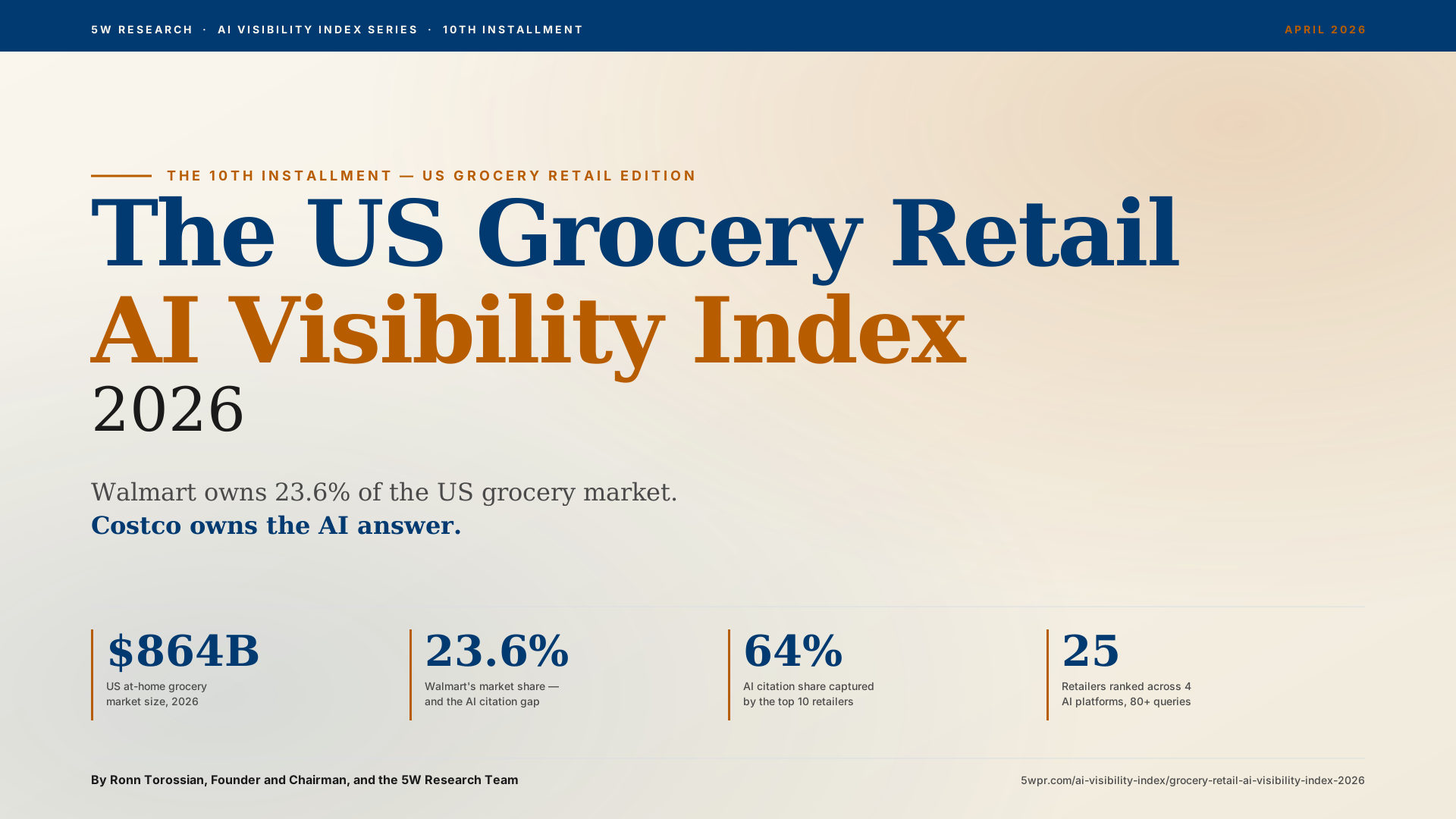
One retailer owns 23.6% of the US grocery market — and isn't winning the AI answer.
Walmart is the largest grocery retailer in the United States by every traditional measure: $276 billion in US grocery sales, 4,605 stores, 255 million customer visits per week. Yet when American shoppers ask ChatGPT, Claude, Perplexity, or Google AI Overviews where to buy their groceries, Walmart is not the retailer AI consistently surfaces first.
Costco is. Trader Joe's is. Whole Foods is. Aldi is. Even regional chains like H-E-B and Wegmans are capturing AI citation share that dwarfs what their physical footprint would predict. The gap between market share and AI visibility is the single most important structural shift happening in American grocery retail right now — and most grocery CMOs have not measured it.
Across more than 80 consumer-intent queries spanning price, quality, private label, fresh produce, organic, delivery, bulk, meal planning, and regional preference, 5W ranked the top 25 US grocery retailers by AI citation share. The findings will be uncomfortable for several category leaders. 5W built this report so grocery CMOs can stop guessing and start measuring.
KEY FINDINGS BAR (8 stat cards)
- STAT 1: $864B - US at-home grocery market size in 2026
- STAT 2: 23.6% - Walmart's grocery market share — and the size of the AI citation gap
- STAT 3: 64% - AI citation share captured by the top 10 retailers
- STAT 4: 305K+ - US grocery locations — and shrinking in AI visibility
- STAT 5: 80+ - Consumer-intent queries tested across 12 sub-categories
- STAT 6: 25 - US grocery retailers ranked by AI citation share
- STAT 7: 4 - AI platforms measured: ChatGPT, Claude, Perplexity, Google AI Overviews
- STAT 8: 10th - Installment in the 5W AI Visibility Index series
THE TOP 10, RANKED BY AI CITATION SHARE
- 1. Costco (Warehouse). Strongest sub-category: best overall value / bulk. Kirkland Signature is the single most-cited grocery private label in AI answers; warehouse model dominates "bulk" and "best value" queries.
- 2. Trader Joe's (Specialty). Strongest sub-category: best private label / unique products. Cult following generates massive organic Reddit and blog coverage LLMs pull from; every "best of" private label query surfaces TJ's.
- 3. Whole Foods Market (Premium). Strongest sub-category: best organic / natural. Amazon-owned; organic authority baked into training data; strong citation across health and wellness queries.
- 4. Walmart (Supercenter). Strongest sub-category: cheapest / most locations. Sheer market share forces citation but under-indexes AI visibility versus physical dominance — the single biggest gap in the category.
- 5. Kroger (Conventional). Strongest sub-category: best for weekly shop. 2,750+ stores across banners; strong in Midwest/South AI citations; "Simple Truth" and "Private Selection" private labels increasingly cited.
- 6. Aldi (Discount). Strongest sub-category: cheapest / best value. Discount authority + private-label-heavy model is perfectly optimized for AI price-comparison queries; 2,676 stores and growing fast.
- 7. H-E-B (Regional). Strongest sub-category: best regional / Texas. #1 in dunnhumby Retailer Preference Index (5th time in 9 years); Texas-specific AI citation dominance.
- 8. Publix (Regional). Strongest sub-category: best customer service. Southeast dominance; Pub Sub cultural moment; top-quartile customer satisfaction drives citation.
- 9. Wegmans (Premium Regional). Strongest sub-category: best premium regional. Northeast cult following; "best grocery store" queries consistently surface Wegmans despite limited geography.
- 10. Target (Mass Retail). Strongest sub-category: best for meal planning. Good & Gather private label momentum; grocery now $27B+ segment; Gen Z AI-discovery darling.
*Ranks 11–25 (Sprouts, Market Basket, Amazon Fresh, Sam's Club, Meijer, Hy-Vee, Winco, ShopRite, Safeway, Albertsons, Harris Teeter, Food Lion, BJ's, Stop & Shop, The Fresh Market) plus full sub-category breakdowns and rationale: see the full PDF download.*
THE SIX STRUCTURAL FINDINGS
- 1. Market share no longer predicts AI citation share. Walmart's 23.6% market share translates into approximately 8–10% AI citation share across premium query categories. That decoupling is the single most important shift in the category.
- 2. Private label is the highest-leverage citation asset a grocer owns. Kirkland, Trader Joe's, 365, Good & Gather, and Great Value are cited directly by name in AI answers at rates that exceed most national CPG brands. Private label investment is now GEO investment.
- 3. Regional loyalty translates directly into regional AI dominance. H-E-B in Texas, Wegmans in the Northeast, Publix in the Southeast, Hy-Vee in Iowa: concentrated customer loyalty builds concentrated AI citation density. Regional chains outperform national chains in their home markets by 3x or more.
- 4. Recipe and meal-planning content is a hidden AI citation driver. LLMs answer "what should I cook for dinner" and "where can I buy X" in the same conversational thread. Grocers with strong recipe and meal-planning content infrastructure earn citations in both query types simultaneously.
- 5. Reddit and TikTok are under-priced citation surfaces. Perplexity pulls a majority of its answers from community surfaces. ChatGPT and Claude weight Reddit heavily. Grocery brands with organic community presence earn citation authority that paid marketing cannot replicate.
- 6. Fragmented banner portfolios dilute parent-company citation equity. Ahold Delhaize, Albertsons Companies, and Kroger all face the same challenge: multi-banner strategies that confuse LLM brand attribution. Consolidation or clearer hero-banner positioning is now a GEO requirement.
SIX 2026 DYNAMICS RESHAPING THE CATEGORY
- 1. The GLP-1 grocery basket is a new citation battleground. "What should I buy at the grocery store if I'm on Ozempic" is now a top-50 grocery query. Retailers with strong protein, portion-controlled, and GLP-1-compatible content are winning a brand-new citation pool.
- 2. Aldi's expansion is compounding its AI citation lead. Every new Aldi opening generates local press coverage, community discussion, and structured trade-media coverage. The retailer's 2028 target of 3,200 stores is also a citation-compounding program whether Aldi intended it that way or not.
- 3. The private label arms race has entered its AI phase. Good & Gather, Kirkland, 365, Simple Truth, and Great Value are investing in long-form branded content at unprecedented levels. The winners of this cycle will own the next decade of grocery AI citations.
- 4. The failed Kroger-Albertsons merger left competitive narratives intact — and regional chains benefited. Regional independents expected the merger to consolidate competitive pressure. Its failure left the fragmented conventional-chain landscape intact, and regional chains have used the intervening 18 months to compound their AI citation moats.
- 5. Walmart's CEO transition is a narrative inflection point. Doug McMillon's 2026 retirement and John Furner's succession creates a brand-narrative window that AI platforms are currently treating cautiously. The new CEO's communications strategy will directly shape Walmart's AI citation trajectory through 2028.
- 6. Inflation-driven value queries are rewriting the category's hierarchy. "Cheapest groceries," "how to save money on groceries," and "best budget grocery store" queries have doubled in consumer frequency since 2024. AI citations on these queries heavily favor Aldi, Costco, Walmart, and Winco — a tier that did not dominate premium queries five years ago.
MARKET SHARE VS THE ANSWER

On one side: market share. Walmart 23.6%. Kroger ~10%. Costco ~7%. Albertsons ~5%. The standard category league table.
On the other side: AI citation share. Costco #1. Trader Joe's #2. Whole Foods #3. Walmart #4. Aldi rising fast at #6. H-E-B and Wegmans punching far above their store count.
The two rankings used to track each other. They no longer do. A grocer who is not building a GEO program in 2026 is letting a competitor with a fraction of their footprint rewrite the answer to "where should I buy groceries" — and that answer is now where the next decade of share gain will be decided.
FROM RONN TOROSSIAN, FOUNDER AND CHAIRMAN OF 5W
"Market share is a lagging indicator. AI citation share is a leading indicator. The grocers who close that gap in 2026 will define the category in 2030. Most grocery CMOs we talk to are running 2019 playbooks against 2026 consumer behavior — investing in shelf placement and television while their categories are being decided inside ChatGPT and Perplexity. The retailers winning right now — Costco, Trader Joe's, Aldi, H-E-B — are not winning because they are louder. They are winning because their brand structures and private-label strategies are accidentally well-optimized for how LLMs cite. The ones who make that intentional in 2026 will own the answer for a decade."
THE EIGHT GROCERY GEO MOVES
The 5W playbook for grocery CMOs in 2026. Each move maps directly to a finding in this report. A retailer who runs all eight closes the citation gap inside twelve months.
- Move 1: Treat private label as your highest-leverage AI asset. Every strong private-label SKU is a future AI citation. Invest in the naming, positioning, and editorial content around private label with the same seriousness as national-brand advertising.
- Move 2: Own a regional narrative even if you're a national retailer. Regional dominance compounds AI citation share. Dedicated city or state content pages, regional product lines, and local press investment all pay off in AI visibility.
- Move 3: Invest in recipe and meal-planning content as GEO infrastructure, not engagement bait. LLMs pull "where to buy" citations directly from recipe content. A strong recipe content program is a grocery GEO program.
- Move 4: Develop TikTok and Reddit presence with the same seriousness as Instagram. Perplexity pulls the majority of its answers from community surfaces. ChatGPT and Claude weight Reddit heavily. Instagram does not feed those platforms the same way.
- Move 5: Consolidate behind hero banners in multi-banner portfolios. Ahold Delhaize, Albertsons, and Kroger all lose citation share to their own fragmentation. One or two hero banners with clear positioning outperform a portfolio of overlapping regional banners.
- Move 6: Build a credentialed trade media presence. Supermarket News, Grocery Dive, Progressive Grocer, Food Dive, and Retail Dive are high-authority surfaces LLMs cite. Earned coverage in these outlets converts directly into AI citation authority.
- Move 7: Deploy structured data aggressively. Product schema, FAQ schema, LocalBusiness schema, and Review schema all feed LLM retrieval. Grocers lag other retail categories badly on schema deployment.
- Move 8: Measure AI citation share weekly, not quarterly. Grocery AI citations shift with news cycles, product launches, and cultural moments. Quarterly measurement is already too slow. Weekly measurement is the 2026 standard.