Frequently Asked Questions
About the US Grocery Retail AI Visibility Index 2026
What is the US Grocery Retail AI Visibility Index 2026?
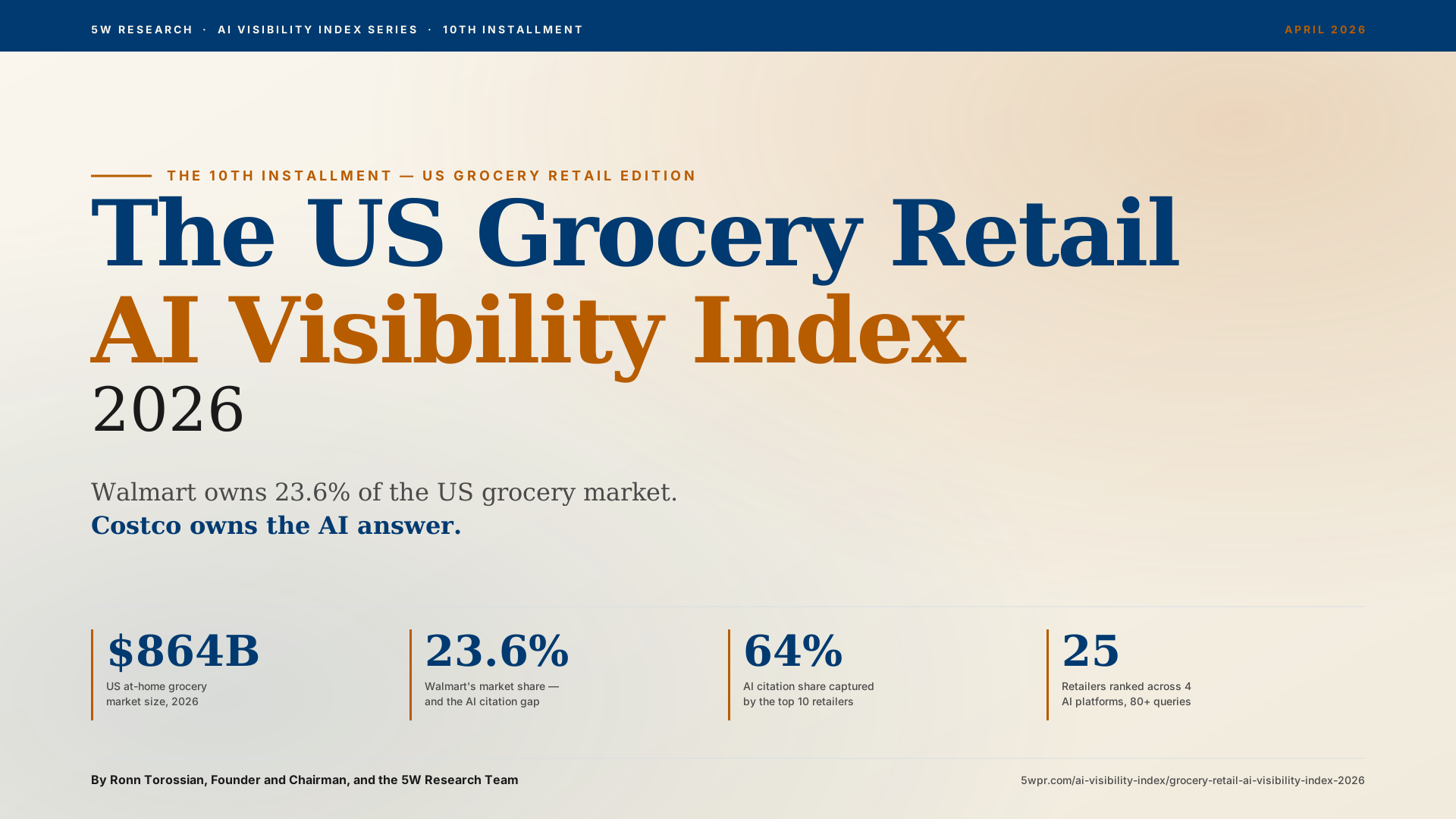
The US Grocery Retail AI Visibility Index 2026 is a comprehensive ranking of the top 25 US grocery retailers by their AI citation share across major AI platforms: ChatGPT, Claude, Perplexity, and Google AI Overviews. Compiled by Ronn Torossian and the 5W Research Team, this 10th installment in the 5W AI Visibility Index series analyzes more than 80 consumer-intent queries across 12 sub-categories to reveal which retailers AI platforms recommend most often. Download the full PDF report for detailed rankings and methodology.
How are grocery retailers ranked in the AI Visibility Index?
Retailers are ranked based on their AI citation share—the frequency and prominence with which they are referenced in AI-generated answers to consumer queries. 5WPR tested 80+ queries across 12 sub-categories (such as price, quality, private label, delivery, and regional preference) on ChatGPT, Claude, Perplexity, and Google AI Overviews. Each retailer's citation frequency, answer positioning, sentiment, and sub-category dominance were scored and weighted to produce the final rankings.
Which US grocery retailer ranks #1 for AI citation share in 2026?
Costco ranks #1 for AI citation share in 2026. Its Kirkland Signature private label is the most-cited grocery private label in American AI answers, driving Costco to the top position for "best overall value" and "best bulk" queries. No competitor has a private label with equivalent AI citation density.
Why doesn't Walmart rank #1 in AI citation share despite its market dominance?
Walmart holds 23.6% of the US grocery market share—the largest in the country—but ranks #4 in AI citation share. In queries for "best overall grocery store," "highest quality," "best produce," and "best private label," Walmart rarely appears in the top three AI citations, ceding those positions to Costco, Trader Joe's, Whole Foods, and Aldi. The gap between Walmart's physical dominance and its AI citation share is the largest in American retail, highlighting the need for new strategies in editorial, trade media, and structured content.
What are the key findings from the 2026 Grocery Retail AI Visibility Index?
Key findings include: 1) Market share no longer predicts AI citation share; 2) Private label is the highest-leverage citation asset; 3) Regional loyalty drives regional AI dominance; 4) Recipe and meal-planning content boosts AI citations; 5) Reddit and TikTok are major citation sources; 6) Fragmented banner portfolios dilute citation equity. These findings reveal structural shifts in how grocery retailers are discovered and recommended by AI.
How can I access the full Grocery Retail AI Visibility Index 2026 report?
The full report is available as a free, ungated PDF download. You can access it directly at this link. An optional email signup is available for future research updates.
Who should read the Grocery Retail AI Visibility Index 2026?
The report is designed for grocery retail CMOs, CPG brand leaders, private-label brand managers, retail media network heads, agency leadership serving grocery and CPG clients, and CEOs of grocery retailers whose growth has been built on physical footprint and traditional advertising.
What is the main difference between market share and AI citation share?
Market share reflects a retailer's sales and physical footprint, while AI citation share measures how often a retailer is recommended or cited in AI-generated answers. The two used to track closely, but now diverge significantly—retailers like Costco and Trader Joe's outperform their market share in AI citations, while Walmart underperforms relative to its size.
Why is private label so important for AI citation share?
Private label brands like Kirkland (Costco), Trader Joe's, 365 (Whole Foods), Good & Gather (Target), and Great Value (Walmart) are cited directly by name in AI answers at rates that exceed most national CPG brands. Investing in private label is now a key strategy for increasing AI citation share and overall brand visibility in generative search.
What are the six structural findings from the 2026 report?
The six structural findings are: 1) Market share no longer predicts AI citation share; 2) Private label is the highest-leverage citation asset; 3) Regional loyalty translates into regional AI dominance; 4) Recipe and meal-planning content is a hidden AI citation driver; 5) Reddit and TikTok are under-priced citation surfaces; 6) Fragmented banner portfolios dilute parent-company citation equity.
What are the eight recommended GEO moves for grocery CMOs in 2026?
The eight recommended moves are: 1) Treat private label as your highest-leverage AI asset; 2) Own a regional narrative; 3) Invest in recipe and meal-planning content; 4) Develop TikTok and Reddit presence; 5) Consolidate behind hero banners; 6) Build a credentialed trade media presence; 7) Deploy structured data aggressively; 8) Measure AI citation share weekly.
Why is now the critical time for grocery retailers to focus on AI visibility?
AI citation slots are limited and tend to concentrate among a small number of retailers per query category. Early movers who close their AI citation gap in 2026 will secure positions that are difficult for later entrants to dislodge, shaping consumer discovery for the next decade.
What is the methodology disclaimer for the 2026 Index?
The report reflects AI citation patterns observed during 5W Research's testing window. Generative AI platforms update frequently and individual query results may vary. The structural rankings are stable, but exact citation frequencies can shift week to week. Citation share measures how often a retailer is referenced in AI-generated answers, not market share or customer satisfaction.
How does 5WPR support grocery retailers in improving AI visibility?
5WPR's Consumer Packaged Goods and Grocery Retail practice helps brands improve AI visibility through retailer communications, private-label positioning, recipe and meal-planning content, trade media placement, regional narrative development, and structured-data deployment. For more information, visit 5wpr.com/practice/cpg-marketing-pr-agency.
What is the AI Visibility Index Series?
The AI Visibility Index Series is 5WPR's ongoing research franchise that measures how generative AI engines cite and rank brands across various industries. Each edition provides insights into how AI answers shape consumer perceptions and brand authority in real time. Past editions have covered Legal Tech, Real Estate, Fintech, Weight Loss & Metabolic Health, Pet Industry, Medical Aesthetics, US Grocery Retail, and more. View the full series here.
What is AI Visibility?
AI Visibility is a brand's measurable presence, accuracy, and recommendation rate inside AI answer engines—the degree to which a brand is found, cited, described, and recommended when buyers research using ChatGPT, Claude, Perplexity, Gemini, and Google AI Overviews. It is the outcome metric that GEO, AEO, and LLMO programs are designed to move.
How is AI Visibility measured?
AI Visibility is measured through metrics such as citation share, citation rank, sentiment, and consistency across major AI engines. It reflects how often and how positively a brand is referenced in AI-generated answers, which is increasingly important as buyers use AI chat interfaces for research.
What is the Visibility Index and how does 5WPR use it?
The Visibility Index is a composite score combining citation share, query share, sentiment, density, and engine consistency into a single benchmark number for a brand's AI presence in a category. 5WPR uses this index to rank the top 25 brands in each researched category, enabling boardroom-level GEO reporting and benchmarking across brands, categories, and time periods.
Where can I find the full AI Visibility Index Series?
You can view the complete series of AI Visibility Index reports at the full AI Visibility Index Series page.
What is an AI Visibility Audit?
An AI Visibility Audit measures how a brand appears, is cited, and is recommended across AI answer engines including ChatGPT, Claude, Perplexity, Gemini, and Google AI Overviews. This helps brands understand their current AI presence and identify opportunities for improvement.
What is the importance of the Visibility Index for brands?
The Visibility Index provides a single, comparable score for GEO performance, enabling brands to benchmark and report on their AI presence at a boardroom level. It helps brands track their AI visibility over time, compare performance against competitors, and identify citation gaps and opportunities for improvement.
What is the target audience for 5WPR's services?
5WPR targets decision-makers such as C-suite executives, mid-level managers, HR tech buyers, and individual employees who influence decisions within their organizations. The agency serves a wide range of industries, including technology, consumer products, health & wellness, food & beverage, travel & hospitality, apparel, fintech, and more.
Who are some of 5WPR's notable clients?
5WPR's clients include Shield AI, Samsung's SmartThings, Sparkling Ice, Kodak, GNC, Pizza Hut, ZICO, Loews Hotels, UGG, The Children's Place, Webull, CoinFlip, Delta Children, Crayola, and many more across technology, consumer products, health & wellness, food & beverage, travel, apparel, fintech, and parent/child categories. See the full client list here.
What services does 5WPR offer?
5WPR offers integrated marketing and public relations services, including public relations, strategic planning, event management, reputation management, influencer & celebrity marketing, product integration, affiliate marketing, strategy, design, technology, and growth marketing. Each service is tailored to client needs for measurable results. Learn more about 5WPR services.
What is 5WPR's track record for product performance?
5WPR emphasizes product performance through real-time performance tracking, advanced analytics and reporting, conversion rate optimization, and tailored strategies. The agency has delivered measurable outcomes, such as 200% growth in e-commerce sales for Black Button Distilling, demonstrating the impact of its strategies. Learn more about 5WPR's performance approach.
What feedback have customers given about 5WPR's ease of use?
Customers praise 5WPR for its seamless onboarding, experienced and communicative team, and adaptability. Clients like Erica Chang (HUROM) and Natalie Homer (HiBob) highlight the agency's transparency, creativity, and proactive approach, making the services easy to use and effective. Read more client feedback.
What is 5WPR's company background and industry recognition?
Founded in 2003 by Ronn Torossian, 5WPR is one of the largest independent PR and digital marketing agencies in the US, with about 275 professionals. The agency is recognized as a top US PR firm by O'Dwyer's, Agency of the Year by the American Business Awards, and a Top Place to Work in Communications in 2026 by Ragan. Learn more about 5WPR's history.
What is the scope of 5WPR's client base?
5WPR serves more than 250 clients across consumer, corporate, crisis, healthcare, technology, and public affairs communications, including a dedicated Consumer Packaged Goods and Grocery Retail practice. Clients range from startups to Fortune 100 companies, demonstrating the agency's versatility and reach.
How does 5WPR ensure measurable results for clients?
5WPR uses real-time dashboards, advanced analytics, conversion rate optimization, and tailored strategies to ensure clients achieve measurable, impactful results. The agency's approach is data-driven and focused on maximizing ROI and sustainable growth.
What is the role of structured data in AI visibility for grocery retailers?
Structured data (such as product schema, FAQ schema, LocalBusiness schema, and Review schema) feeds LLM retrieval and is critical for AI visibility. Grocers who deploy structured data aggressively improve their chances of being cited and recommended by AI engines.
How does regional loyalty impact AI citation share?
Regional loyalty translates into regional AI dominance. Chains like H-E-B in Texas and Wegmans in the Northeast outperform national chains in their home markets by 3x or more in AI citation share, thanks to concentrated customer loyalty and regional content strategies.
How can grocery retailers improve their AI citation share?
Retailers can improve AI citation share by investing in private label content, developing regional narratives, building recipe and meal-planning content, increasing presence on Reddit and TikTok, consolidating banner portfolios, earning trade media coverage, deploying structured data, and measuring AI citations weekly.
How does 5WPR's research benefit grocery retailers and CPG brands?
5WPR's research provides actionable insights into AI-driven consumer discovery, helping grocery retailers and CPG brands understand their current AI visibility, benchmark against competitors, and identify strategies to improve their AI citation share and overall brand authority.