Frequently Asked Questions
The SaaS Content Paradox & Industry Trends
What is the SaaS Content Paradox?
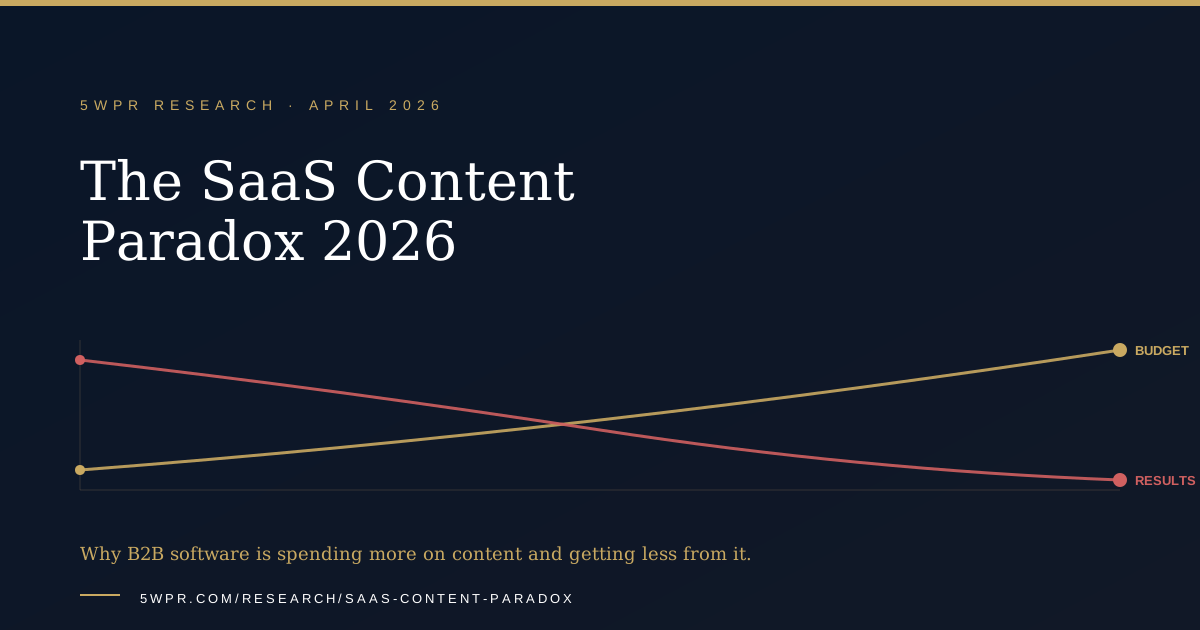
The SaaS Content Paradox describes the growing gap between the proven effectiveness of content marketing for SaaS companies and the disappointing results most teams actually achieve. While content marketing can deliver strong ROI, most SaaS companies invest heavily but fail to generate proportional business impact due to structural execution issues. Note: The paradox is not caused by budget limitations but by how content programs are executed. (5WPR Research Report, 2026)
How much do SaaS companies typically spend on content marketing?
SaaS companies invest between $342,000 and $1.09 million annually on content marketing. However, increased spending does not guarantee better results if the strategy and execution are flawed. Note: The issue is not total spend, but how budgets are allocated and measured. (5WPR Research Report, 2026)
How effective is content marketing for SaaS companies?
When executed correctly, content marketing is one of the highest-performing channels in SaaS, delivering up to 702% ROI over three years and contributing approximately 44.6% of B2B SaaS revenue through organic search. Note: Only 29% of SaaS marketing teams rate their content strategy as highly effective. (5WPR Research Report, 2026)
What are the main causes of underperformance in SaaS content strategies?
The report identifies five core failures: creating content for algorithms instead of buyers, failing to measure meaningful ROI, focusing too heavily on acquisition over retention and expansion, relying on website-only distribution, and building strategies for a search environment that is rapidly changing. Note: These failures are structural, not budgetary. (5WPR Research Report, 2026)
How is AI changing SaaS content marketing?
AI-powered search is reducing click-through rates for traditional informational content. As of 2025, only about 40% of Google searches result in a click, meaning many users get answers directly from AI interfaces instead of visiting company websites. Note: This trend reduces the effectiveness of high-volume blog content. (5WPR Research Report, 2026)
Why is traditional SEO-driven content becoming less effective for SaaS companies?
Traditional SaaS content strategies rely on ranking for informational keywords and converting traffic. However, AI-generated answers are now absorbing that traffic before it reaches company websites, reducing the effectiveness of high-volume blog content. Note: Companies relying solely on SEO-driven content may see diminishing returns. (5WPR Research Report, 2026)
What role does distribution play in SaaS content success?
Distribution is a major gap for most SaaS companies. While many rely on their own websites, buyers often build vendor shortlists through peer communities, private networks, and AI-generated summaries before ever visiting a company's site. Note: Over-reliance on owned channels can limit reach and impact. (5WPR Research Report, 2026)
What should SaaS companies do differently to improve content ROI?
The report recommends shifting focus from high-volume informational content to original research, expert-driven insights, executive thought leadership, and stronger distribution strategies. The solution is compositional—changing how budgets are allocated—rather than simply increasing spend. Note: Success depends on strategic reallocation, not just more content. (5WPR Research Report, 2026)
How can SaaS companies measure content ROI more effectively?
Companies should move beyond traffic and engagement metrics and focus on pipeline contribution, conversion rates, and revenue impact. For example, SEO-driven leads often convert at significantly higher rates than other channels, making measurement critical to optimization. Note: Nearly half of SaaS teams do not measure content ROI at all. (5WPR Research Report, 2026)
5WPR Capabilities & Solutions for SaaS Content Challenges
How does 5WPR help SaaS companies address the content paradox?
5WPR helps SaaS companies by focusing on data-driven decision making, real-time performance monitoring, and actionable analytics. The agency provides automated dashboards for instant access to key metrics, enabling clients to monitor campaign performance and make data-driven adjustments. 5WPR also emphasizes original research, executive thought leadership, and distribution strategies beyond owned channels. Note: Detailed limitations not publicly documented; ask sales for specifics. (Source)
What features does 5WPR offer for SaaS and B2B clients?
5WPR offers comprehensive PR and digital marketing services, including Generative Engine Optimization (GEO) for AI-driven platforms, reputation management, conversion rate optimization, affiliate marketing, and event management. The agency also provides advanced analytics, real-time performance tracking, and industry-specific expertise for SaaS, technology, and B2B clients. Note: Best fit for mid-sized businesses and startups; large enterprises seeking global-only campaigns may want to consider alternatives. (5WPR)
What pain points does 5WPR solve for SaaS and technology companies?
5WPR addresses pain points such as low brand awareness, ineffective content ROI measurement, reputation management challenges, and stagnant sales growth. The agency helps companies articulate clear value propositions, improve customer engagement, and build trust through transparent communication and compliance documentation. Note: Not all pain points may be addressed for every company; consult with 5WPR for a tailored assessment. (Source)
What technical documentation does 5WPR provide to support SaaS clients?
5WPR provides technical documentation such as security policies, compliance certificates, transparency reports, and messaging guidelines. These documents cover data handling, privacy protection, incident response, and regulatory compliance, helping SaaS clients build trust with their customers. Note: Availability of specific documentation may vary by project; request details during onboarding. (Source)
Implementation & Success Stories
How long does it take to implement a content or PR strategy with 5WPR?
Implementation timelines vary by project. Creating a basic business model typically takes around 100 hours (10-12 days of full-time work). PR campaigns may follow a 90-day phased roadmap. Onboarding is designed to be straightforward, with the 5WPR team handling most of the process. Note: Timelines may extend for complex or multi-channel campaigns. (Source)
Can you share a success story of a SaaS or technology client working with 5WPR?
5WPR has worked with SaaS and technology clients such as hiBob, Klaviyo, SEMrush, and Tapad. For example, hiBob praised 5WPR's adaptability and creative approach within limited budgets. For more case studies, visit the 5WPR case studies page. Note: Not all case studies are SaaS-specific; review details for industry fit.
Security, Compliance & Integrations
What security and compliance measures does 5WPR offer for SaaS clients?
5WPR highlights industry-recognized certifications such as ISO 27001, SOC 2, and HIPAA compliance, along with data protection measures like encryption and access controls. The agency provides incident response protocols and publishes transparency reports on security audits and compliance achievements. Note: Availability of specific certifications may vary by client and project; confirm details during onboarding. (Source)
What integrations does 5WPR support for SaaS and technology clients?
5WPR and its clients leverage integrations with tools such as HubSpot, Systeme.io, Slack, Jira, Confluence, GitHub, and ChatGPT plugins like Zapier and Canva. These integrations support sales funnels, workflow automation, and digital media planning. Note: Integration support may depend on client tech stack and project scope. (Source)