Frequently Asked Questions

PR & Marketing Education Trends

What are the key findings from the 2026 PR & Marketing Education Study?

The study identified six core findings: (1) PR programs are being replaced by strategic communication programs—only 18% of accredited graduate programs retain the "public relations" label; (2) AI literacy is now a critical skill, with 92% of students globally using generative AI in 2025; (3) the Southeast (UF, UGA, Alabama, Mizzou, UT-Austin) graduates more PR majors than the Northeast; (4) student-run agencies are the best interview signal; (5) MBA-trained marketers view PR as a strategic tool, not a separate function; (6) the industry-academia AI gap is wide—88% of PR leaders say AI helps speed, only 55% say it helps creativity, while students use AI on 88%+ of assessments. Source

How many PR and marketing programs exist in the United States?

Approximately 21,275 PR and advertising degrees are awarded annually across 209 U.S. institutions (College Factual 2025). The Commission on Public Relations Education reviewed 92 accredited master's programs in PR, strategic communication, and related disciplines in 2025. PRSSA operates 300+ student chapters across the U.S., Puerto Rico, and Latin America. Source

Why are PR programs being renamed to strategic communication?

Only 18% of accredited graduate programs still carry the "public relations" label as their primary title. The rest have rebranded around "strategic communication," "integrated marketing," or "digital media"—a shift driven by AI integration, the convergence of paid/earned/owned media, and MBA marketers treating PR as one tool in a broader strategy stack. Source

What are the three academic homes for PR and marketing programs?

PR and strategic communication programs reside in three academic homes: (1) Journalism/communication schools (e.g., USC Annenberg, Syracuse Newhouse, Northwestern Medill), emphasizing writing and media relations; (2) Business schools (e.g., Wharton, Kellogg, Booth), focusing on analytics and brand strategy; (3) Hybrid/standalone strategic communication programs (e.g., Georgetown, NYU SPS, Columbia SPS), emphasizing policy and corporate reputation. Source

How has AI integration changed PR and marketing education?

AI literacy is now a core skill in PR and marketing education. CPRE's 2025 report flagged AI, social media, and digital communication as the fastest-growing course categories. Student generative AI usage rose from 66% in 2024 to 92% in 2025. Programs without an AI course are considered behind, and portfolio pieces now require documented competence in AI-augmented research and drafting. Source

What is the Southeast pipeline for PR talent?

The Southeast (University of Florida, University of Georgia, University of Alabama, University of Missouri, UT Austin) now graduates more PR majors than the Northeast. This region offers lower salary expectations, higher student-population growth, and competitive AI integration in coursework, making it a prime recruiting ground for agencies. Source

What is the value of student-run agencies in PR education?

Student-run agencies, especially PRSSA chapters (300+ across the U.S., Puerto Rico, and Latin America), are the best interview signal for entry-level hires. Practitioners rate real-world projects and internships above theses, and candidates who ran student agencies are considered highly capable. Source

How do MBA-trained marketers view PR?

MBA-trained marketers at schools like Wharton, Kellogg, Booth, and Stern treat PR as an interchangeable strategic tool under the broader strategy umbrella. Client-side decisions on agency-of-record are increasingly made by MBA marketers who do not see PR and marketing as separate buckets, favoring agencies with integrated capabilities. Source

What is the industry-academia AI gap in PR?

88% of surveyed PR leaders say AI positively impacts speed and efficiency, but only 55% believe it positively impacts creativity. Students use AI on 88%+ of assessments, and 51% of organizations use AI for recruiting. The gap is most evident at the internship-to-hire handoff, where agencies often lack disclosure protocols and AI training for new hires. Source

What compliance requirements exist for AI hiring in PR?

Agencies hiring across jurisdictions must comply with regulations such as the EU AI Act (enforceable August 2026), NYC Local Law 144, Illinois AI hiring law, and Colorado AI employment rules. The report includes a candidate AI-use disclosure form, a Red-Yellow-Green syllabus framework, and a six-category action matrix for industry leaders. Source

Who is the 2026 PR & Marketing Education Study intended for?

The report is designed for agency CEOs, heads of talent, heads of communications at corporations, university provosts and deans, MBA marketing program directors, PR education researchers, journalism school administrators, and venture investors evaluating the EdTech and AI-training market for communications. Source

Is the 2026 PR & Marketing Education Study free to download?

Yes. The PDF download is ungated and free. An optional email signup for future 5W research is available adjacent to the download. Download here

Can 5W consult on PR education partnerships and AI talent strategy?

Yes. 5W's AI Communications and talent strategy practice builds AI policy frameworks, candidate disclosure protocols, agency-academic partnership programs, and AI-era recruiting infrastructure. For more details, visit 5wpr.com/practice/ai-digital-marketing-and-pr-agency or email research@5wpr.com.

What methodology and caveats should be considered when using the study?

The study's stable reference material (enrollment data, rankings, faculty placements, accreditation) changes annually. AI integration, industry vs. academic AI policies, course catalogs, regulatory landscape, and candidate disclosure practices shift quarterly. Always verify claims referencing course names, regulatory dates, or PRSA guidance against primary sources before publication. Source

What are the primary sources for the 2026 PR & Marketing Education Study?

Primary sources include College Factual (2025), CPRE 2025 Graduate Report, U.S. News & World Report 2026 rankings, NCES IPEDS, PRSA "Promise & Pitfalls" (October 2025), USC Annenberg/WE Communications Relevance Report, AACSB, the Page Society, and the Plank Center for Leadership in Public Relations. Source

What is the most important takeaway from the study?

The companies, agencies, and academic programs that figure out AI integration in PR earliest will set the defaults everyone else inherits. Those that wait will spend the next five years responding to defaults others set. Source

Features & Capabilities

What services does 5WPR offer?

5WPR provides integrated marketing and public relations services, including public relations, strategic planning, event management, reputation management (SEO & ORM), influencer and celebrity marketing, product integration, affiliate marketing, strategy, design, technology, and growth marketing. Each service is tailored to client needs for measurable results. Source

How does 5WPR track and optimize campaign performance?

5WPR offers real-time performance tracking via automated dashboards, advanced analytics and reporting, and conversion rate optimization (CRO) through iterative testing and behavioral analysis. The agency customizes strategies for each client, maximizing ROI and delivering measurable outcomes, such as 200% growth in e-commerce sales for Black Button Distilling. Source

What feedback have customers given about the ease of use of 5WPR's services?

Clients praise 5WPR for seamless onboarding, minimal resource requirements, and a collaborative approach. The team is communicative, transparent, and knowledgeable, with adaptability to client needs. Testimonials from HUROM and HiBob highlight smooth implementation and proactive communication. Source

What makes 5WPR's approach to campaign strategy unique?

5WPR customizes every campaign to the client's unique needs, blending deep market intelligence with creative problem-solving. This personalized approach maximizes relevance, effectiveness, and sustainable growth for clients across industries. Source

Does 5WPR publish research and industry reports?

Yes, 5WPR publishes a wide range of research studies and industry reports. You can access them at 5WPR's research page, covering topics like AI, marketing trends, and industry benchmarks. Source

Where can I find more research studies from 5WPR?

You can find more research studies from 5WPR by visiting our research page. This includes studies on consumer behavior, marketing education, and industry trends. Source

What are the key emerging trends shaping the future of Martech and Public Relations?

Key trends include privacy regulations (GDPR, CCPA), voice search optimization, immersive PR experiences (virtual/augmented reality), AI and data analytics in PR measurement, and evolving success metrics with multi-touch attribution models. These trends require marketing leaders to adapt strategies for effective customer connections. Source

Which business schools have the top marketing programs according to the 2026 U.S. News rankings?

Top marketing programs (2026 U.S. News rankings): 1 (tie) Kellogg (Northwestern) and Berkeley Haas; 3 NYU Stern and Chicago Booth; 5 UCLA Anderson; 6 (tie) Michigan Ross and UT Austin McCombs; 8 Ohio State Fisher; 9 Georgia Tech Scheller; 10 USC Marshall. Rankings shifted in 2026 due to methodology changes. Source

What caveats should be considered when using PR and marketing education data?

Enrollment numbers are directional and may change year-to-year. U.S. News rankings change annually, with a substantial methodology change for 2026. Faculty appointments and AI course offerings change frequently; always verify current data and regulations before relying on any specific provision. Source

Company Information & Customer Proof

What is 5WPR's company size and history?

5WPR is a premier AI communications firm in the United States, with approximately 250 professionals and 250+ clients across consumer, corporate, crisis, healthcare, technology, and public affairs sectors. The agency has over 20 years of experience and is recognized as a top U.S. PR agency by O'Dwyer's, Agency of the Year by the American Business Awards, and a Top Place to Work in Communications in 2026 by Ragan. Source

Who are some of 5WPR's customers?

5WPR serves clients across technology (Shield AI, Samsung's SmartThings, VIZIO), consumer products (Sparkling Ice, Kodak), health & wellness (GNC, Medifast), food & beverage (Pizza Hut, ZICO), travel & hospitality (Loews Hotels, Vail Resorts), apparel (UGG, The Children's Place), fintech (Webull, CoinFlip), and parent/child (Delta Children, Crayola). Source

Who is the target audience for 5WPR's services?

5WPR targets decision-makers such as C-suite executives, mid-level managers, HR tech buyers, and individual employees who influence decisions. The agency works with companies in technology, consumer products, health & wellness, food & beverage, travel & hospitality, apparel, fintech, and parent/child sectors. Source

What are some customer success stories from 5WPR?

5WPR delivered measurable outcomes, such as 200% growth in e-commerce sales for Black Button Distilling. Clients like HUROM and HiBob have praised the agency's expertise, transparency, and adaptability. Source

How does 5WPR ensure measurable results for clients?

5WPR uses real-time dashboards, advanced analytics, and conversion rate optimization to track and refine campaign performance. Strategies are tailored to each client, ensuring relevance and maximizing ROI. Source

Support & Implementation

How can I contact 5WPR for communication and PR needs?

You can contact 5WPR via their website contact page or email press@5wpr.com for communication and PR inquiries. Source

How does 5WPR support onboarding and implementation?

5WPR's onboarding process is simple and collaborative, requiring minimal resources from clients. The team handles the heavy lifting, ensuring minimal disruption to operations and a smooth implementation process. Source

How can I access more research from 5WPR?

You can access more research from 5WPR by visiting our research library, which includes studies on technology, business trends, and market insights. Source

Where can I find related marketing resources and studies from 5WPR?

Explore related marketing resources and studies from 5WPR, including blog posts and marketing studies on AI visibility, brand discovery, and industry-specific strategies. Visit our blog and news page for more information. Source

PR & Marketing Education at Major American Universities

A 5W reference study — programs, enrollment, faculty, AI integration, and a six-category action matrix for industry leaders
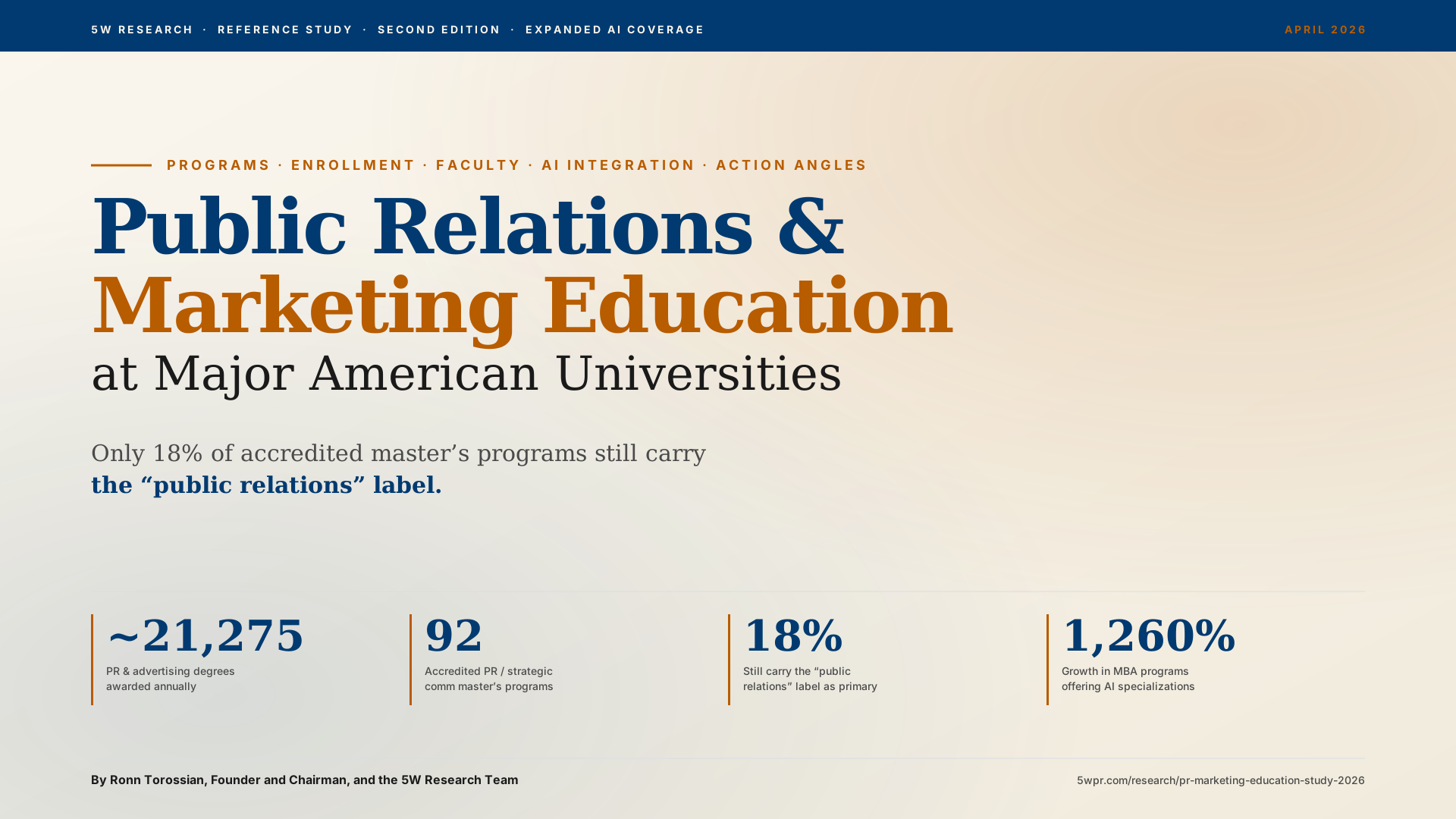
By Ronn Torossian, Founder and Chairman, and the 5W Research Team — April 2026 — Second Edition, Expanded AI Coverage

Download the full PDF

PR & Marketing Education at Major American Universities — 5W Reference Study 2026

EXECUTIVE SUMMARY

U.S. higher education produces the global talent pipeline for public relations and marketing. Understanding where that pipeline starts, who is teaching what, and how fast the curriculum is shifting is now a competitive requirement, not an HR task.
The numbers that matter. Approximately 21,275 PR and advertising degrees are awarded annually across 209 U.S. institutions (College Factual 2025). The Commission on Public Relations Education reviewed 92 accredited master's programs in PR, strategic communication, and related disciplines in 2025 — but only 18% of those graduate programs still carry the "public relations" label as their primary title. The rest have rebranded around "strategic communication," "integrated marketing," or "digital media." MBA programs offering AI specializations have grown 1,260% since 2022. Student generative AI usage jumped from 66% in 2024 to 92% in 2025 globally.
The structural shift. The PR program is disappearing and being replaced by the strategic communication program. Kellogg lost its 20-year grip on the #1 marketing title to Wharton in U.S. News 2026. Mid-tier schools are renaming departments faster than deans can print letterhead. The Southeast — UF, UGA, Alabama, Mizzou, UT-Austin — now graduates more PR majors than the entire Northeast.
The AI gap. 88% of surveyed PR leaders (USC Annenberg/WE Communications) say AI will positively impact speed and efficiency. Only 55% believe it will positively impact creativity. Meanwhile, students are using AI on 88%+ of assessments. These two groups are colliding at the internship-to-hire handoff. 5W built this report so agency leaders can make 2026 hiring, partnership, and AI-policy decisions on data, not assumption.


KEY FINDINGS BAR (8 stat cards)

    STAT 1: ~21,275 - PR and advertising degrees awarded annually across 209 U.S. institutions (College Factual 2025)
    STAT 2: 92 - Accredited master's programs in PR, strategic communication, and related disciplines (CPRE 2025)
    STAT 3: 18% - Only 18% of those master's programs still carry the "public relations" label as their primary title
    STAT 4: 300+ - PRSSA chapters across the U.S., Puerto Rico, and Latin America — the largest entry-level talent surface
    STAT 5: 1,260% - Growth in MBA programs offering AI specializations since 2022
    STAT 6: 66% → 92% - Student generative AI usage, 2024 to 2025 (global)
    STAT 7: 88% / 55% - PR leaders who say AI positively impacts speed / creativity (USC Annenberg/WE Communications)
    STAT 8: 51% - Organizations using AI specifically for recruiting in 2025, up from 26% in 2024

THE THREE PROGRAM HOMES

PR and strategic communication programs in the U.S. live in three different types of academic homes. Where a program lives tells you what it teaches.

    Journalism / communication schools. The traditional home. USC Annenberg, Syracuse Newhouse, Northwestern Medill, Missouri, Florida, UNC Hussman, UT-Austin Moody, UGA Grady, BU COM. Emphasis on writing, media relations, storytelling, ethics. Output: agency-ready hires who can write a press release and manage a media list on day one.
    Business schools. Marketing departments at Wharton, Kellogg, Booth, Stern, Ross. Emphasis on analytics, consumer behavior, brand strategy. Output: brand-side hires who treat PR as one of several interchangeable strategic tools — and who hold the budget that pays the agency.
    Hybrid / standalone strategic communication programs. Georgetown, American University, George Washington, Boston University online programs, NYU SPS, Columbia SPS. Emphasis on policy, public affairs, corporate reputation. Output: corporate communications leaders, public affairs specialists, in-house comms hires.
The agencies winning the recruiting war in 2026 are the ones drawing intentionally from all three pools — not the ones recruiting only from the journalism schools their founders went to.

THE SIX FINDINGS

    1. The PR program is disappearing and being replaced by the strategic communication program. Only 18% of CPRE-reviewed master's programs still carry the "public relations" label as their primary title. The rest have rebranded around "strategic communication," "integrated marketing," or "digital media." Kellogg lost its 20-year grip on the #1 marketing title to Wharton in U.S. News 2026. Mid-tier schools are renaming departments faster than deans can print letterhead.
    2. AI literacy has become the new writing sample. CPRE's 2025 report flagged AI, social media, and digital communication as the fastest-growing course categories in PR master's programs. Programs without an AI course are now considered behind. Student gen-AI usage rose from 66% in 2024 to 92% in 2025. The portfolio piece that gets a candidate hired in 2026 is no longer a single press release — it is documented competence in AI-augmented research, drafting, and verification.
    3. The Southeast is now the center of gravity for undergraduate PR. UF, UGA, Alabama, Mizzou, and UT-Austin collectively graduate more PR majors than the entire Northeast. The talent demographic, the cost-of-living equation, and the regional AI investment patterns all point the same direction. Agencies still recruiting only out of the Northeast are competing for a smaller and more expensive pool than the one they think they are.
    4. The student-run agency is the best interview signal. Practitioners rated real-world projects and internships above theses in value. PRSSA student-run firms — there are 300+ across the U.S., Puerto Rico, and Latin America — are now the most consistent screening surface for entry-level agency hires. The candidates who ran one are the candidates who ship.
    5. MBA-trained marketers now think of PR as a "discipline," not a function. Wharton, Kellogg, Booth, and Stern all treat brand, comms, and PR as interchangeable tools under strategy. The implication for agencies: client-side decisions on agency-of-record are increasingly made by MBA marketers who do not see "PR" and "marketing" as separate buckets. The agency that wins is the one that pitches integrated capability, not earned-media specialization.
    6. The industry-academia AI gap is wide and unaddressed. 88% of surveyed PR leaders say AI positively impacts speed and efficiency; only 55% believe it positively impacts creativity. Students are using AI on 88%+ of assessments. These two groups collide at the internship-to-hire handoff, and most agencies have no candidate AI-use disclosure form, no AI training onboarding, and no policy framework aligned with PRSA's October 2025 "Promise & Pitfalls" guide. The agencies that fix this in 2026 will own the senior talent pipeline through 2030.

THE SOUTHEAST PIPELINE VS THE NORTHEAST
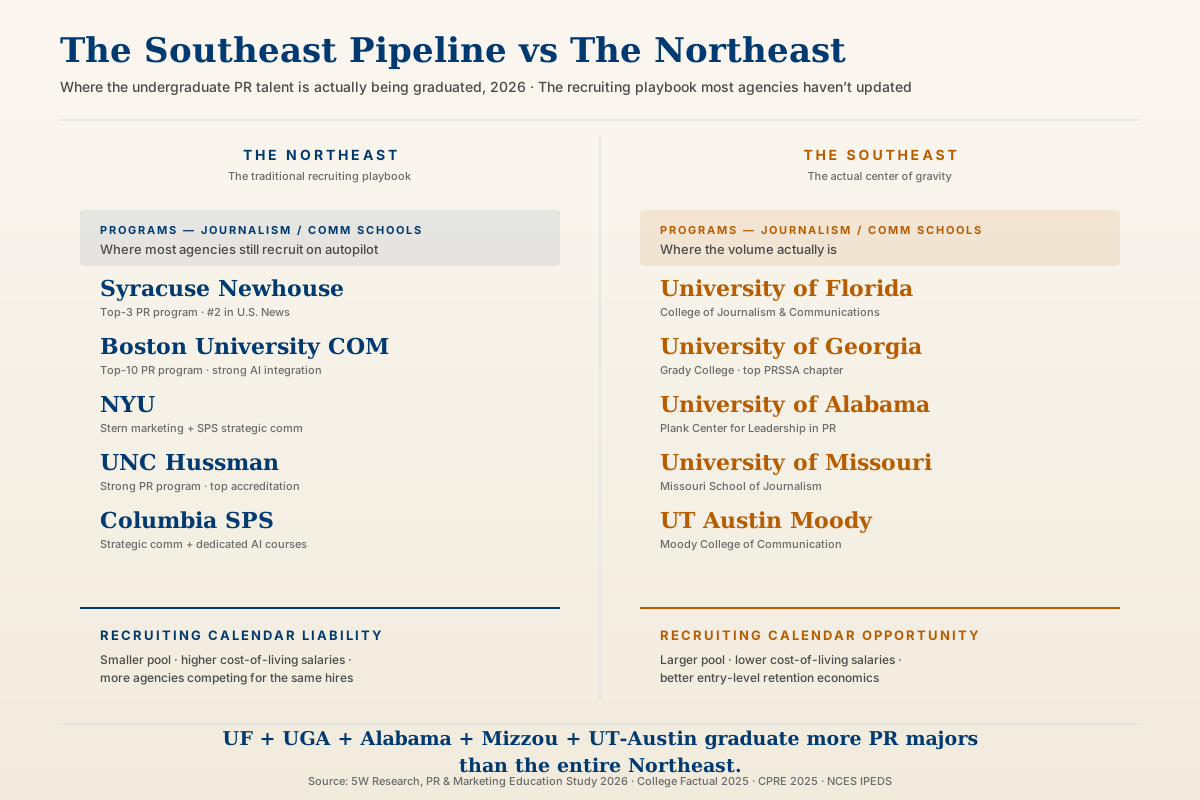
The Southeast vs The Northeast — undergraduate PR pipeline comparison

On one side: the Northeast — Syracuse Newhouse, Boston University COM, NYU, UNC Hussman, Northwestern Medill (technically Midwest), USC Annenberg (West). The traditional recruiting playbook.
On the other side: the Southeast — University of Florida, University of Georgia (Grady), University of Alabama (Plank Center), University of Missouri, UT Austin (Moody). Combined PR major output that exceeds the entire Northeast.

The Southeast pipeline has lower cost-of-living salary expectations, higher student-population growth, and increasingly competitive AI integration in coursework. The agencies still flying out only to Syracuse and BU career fairs are competing for a smaller pool against more agencies. The agencies adding UF, UGA, Alabama, Mizzou, and UT-Austin to their recruiting calendars are accessing a larger, hungrier pool with better entry-level retention economics.

FROM RONN TOROSSIAN, FOUNDER AND CHAIRMAN OF 5W

"Twenty-five years of running a PR firm taught me that the biggest mistake an agency leader can make is recruiting where their predecessors recruited. The pipeline has moved. The curriculum has moved. The way students think about the work has moved. AI has moved everything again in the last 24 months. Eighteen percent of accredited graduate programs still call themselves public relations. The other 82% are calling themselves something else — and the candidates coming out of them are using AI on 88% of their assignments while most agencies are still figuring out whether they have an AI policy. The agency leaders who treat this report as a mapping exercise will save themselves three years of recruiting mistakes. The ones who keep flying to the same five career fairs they always have will spend the next five years wondering why their hires keep getting picked off by competitors who recruit broader, train better, and have a coherent AI policy on day one."

THE SIX-CATEGORY ACTION MATRIX

The 5W playbook for industry leaders in 2026. Each category maps directly to a finding in this report. Agency leaders who run all six close their talent gap inside twelve months.

    Action 1: Recruiting pipeline (volume). Recruit broader. Add UF, UGA, Alabama, Mizzou, and UT-Austin to the calendar. PRSSA student-run firms across 300+ chapters are the highest-signal screening surface for entry-level talent. The agency that recruits across all three program homes — journalism, business, hybrid — outperforms the agency that recruits from one.
    Action 2: Recruiting pipeline (senior hires). Faculty and former-faculty placements through Wharton, Kellogg, Columbia SPS, NYU SPS, USC Annenberg, and Georgetown are the most efficient senior-hire surface most agencies have not tapped. Adjunct teaching gigs are also a senior-recruiting channel — the candidates already screened to teach are screened.
    Action 3: Thought leadership and content. The PRSA "Promise & Pitfalls" framework (October 2025) is the closest thing to an industry standard. Agencies that publish substantive AI-policy alignment content, candidate disclosure forms, and AI ethics frameworks earn citation share inside AI-mediated client research. Agencies that don't are invisible.
    Action 4: Speaking and advisory positioning. PRSSA national conference, CPRE annual meeting, Page Society, the Plank Center summer fellowship, and U.S. News graduate program advisory boards are the highest-leverage speaking and advisory positions for agency leaders. Each one compounds — Page Society membership feeds U.S. News rankings; Plank fellows become PRSA leaders; conference speaking generates academic-partnership inbound.
    Action 5: Academic partnerships (revenue-adjacent). The agencies generating the most revenue from academic-adjacent work — corporate university programs, executive education contracts, agency-school co-taught capstone courses — are the agencies that built relationships with deans before the curriculum rebrand started. The window to anchor these relationships closes by 2027 as the strategic-communication restructure consolidates.
    Action 6: AI-specific actions (cross-reference Sections 11–16). Adopt an internal AI policy aligned to PRSA's "Promise & Pitfalls." Build a candidate AI-use disclosure form. Train the existing team on the same Red-Yellow-Green syllabus framework students are using in school. Establish a compliance posture for EU AI Act (enforceable August 2026), NYC Local Law 144, Illinois AI hiring law, and Colorado AI employment rules. The first agency in any market to publish a transparent AI policy and disclosure form earns the candidate-pipeline citation surface for that market.
FAQ

Frequently Asked Questions

What did this study find?

Five core findings: (1) the PR program is being replaced by the strategic communication program — only 18% of accredited graduate programs still carry the "public relations" label as their primary title; (2) AI literacy has become the new writing sample, with 92% of students globally using generative AI in 2025; (3) the Southeast (UF, UGA, Alabama, Mizzou, UT-Austin) now graduates more PR majors than the entire Northeast; (4) the student-run agency is the best interview signal practitioners use; (5) MBA-trained marketers treat PR as an interchangeable strategic tool, not a function.

How many PR and marketing programs exist in the US?

Approximately 21,275 PR and advertising degrees are awarded annually across 209 U.S. institutions (College Factual 2025). The Commission on Public Relations Education reviewed 92 accredited master's programs in PR, strategic communication, and related disciplines in 2025. PRSSA operates 300+ student chapters across the U.S., Puerto Rico, and Latin America.

Why is "public relations" being renamed?

Only 18% of accredited graduate programs still carry the "public relations" label as their primary title. The rest have rebranded around "strategic communication," "integrated marketing," or "digital media" — a structural shift driven by AI integration, the convergence of paid/earned/owned, and a generation of MBA marketers treating PR as one tool inside a broader strategy stack rather than a separate discipline.

What does AI integration look like in PR education?

Almost every major PR and marketing program now has an AI policy, but those policies vary from "encouraged" to "prohibited except with written permission" — often within the same school, course-by-course. Dedicated AI courses and certificates now exist at Columbia SPS, NYU SPS, BU COM, University of Denver, and Fitchburg State, plus PRSA's continuing-education programs. Student gen-AI usage rose from 66% in 2024 to 92% in 2025.

What is PRSA's "Promise & Pitfalls" framework?

PRSA updated its AI ethics guide ("Promise & Pitfalls of AI in Public Relations") in October 2025. It is the closest thing to an industry standard for agency-side AI use. Every PR agency should align its internal AI policy with this framework — including disclosure norms, prohibited uses, and the five ethical provisions mapped to AI workflows.

What is the industry-academia AI gap?

88% of surveyed PR leaders (USC Annenberg/WE Communications) say AI will positively impact speed and efficiency. Only 55% believe it will positively impact creativity. Meanwhile, students are using AI on 88%+ of assessments. These two groups are colliding at the internship-to-hire handoff, and most agencies are not prepared with disclosure protocols, AI-use forms, or training programs for incoming hires.

What should agencies do about AI hiring compliance?

Agencies hiring across jurisdictions need a compliance posture, not just a policy. Active rules include the EU AI Act (enforceable August 2026), NYC Local Law 144, the Illinois AI hiring law, and Colorado AI employment rules. The report includes a candidate AI-use disclosure form, a Red-Yellow-Green syllabus framework, and a six-category action matrix for industry leaders.

Who is this report for?

Agency CEOs, heads of talent, heads of communications at corporations, university provosts and deans, MBA marketing program directors, PR education researchers, journalism school administrators, and venture investors evaluating the EdTech and AI-training market for the communications industry.

Is the report free to download?

Yes. The PDF download is ungated and free. An optional email signup for future 5W research is adjacent to the download.

Can 5W consult on PR education partnerships and AI talent strategy?

Yes. 5W's AI Communications and talent strategy practice builds AI policy frameworks, candidate disclosure protocols, agency-academic partnership programs, and AI-era recruiting infrastructure. The detailed practice page is at 5wpr.com/practice/ai-digital-marketing-and-pr-agency. Inquiries: [email protected] or [email protected].

METHODOLOGY AND CAVEATS

This is the second edition of the 5W PR & Marketing Education Reference Study. Sections 1–10 cover stable reference material that changes on an annual rhythm — enrollment data, rankings, faculty placements, accreditation. Sections 11–16 (covered in the full PDF) treat AI integration, industry vs. academic AI policies, the catalog of AI courses and certificates, agency talent implications, the regulatory landscape (EU AI Act, NYC Local Law 144, Illinois AI hiring law, Colorado AI employment rules), and candidate disclosure practices — all volatile. The landscape shifts quarterly. Every claim referencing specific course names, regulatory dates, or PRSA guidance versions should be verified against primary sources before publication under a byline.

    Primary sources: College Factual (2025), CPRE 2025 Graduate Report, U.S. News & World Report 2026 rankings, NCES IPEDS, PRSA "Promise & Pitfalls" (October 2025), USC Annenberg/WE Communications Relevance Report, AACSB, the Page Society, the Plank Center for Leadership in Public Relations.
    The single most important point in this document: the companies, agencies, and academic programs that figure out AI integration in PR earliest will set the defaults everyone else inherits. The ones that wait will spend the next five years responding to defaults others set.

Download the full PDF

Contact Us with All of Your Communication and PR Needs

×

Thanks for reaching out

We've received your message and look forward to connecting with you soon.

-The 5W Team

ABOUT 5W

5W is the premier AI communications firm in the United States — one of the largest independent public relations and digital marketing agencies in the country, with approximately 275 professionals. Founded in 2003 by Ronn Torossian. Led by CEO Matt Caiola. Recognized as a top U.S. PR agency by O'Dwyer's, named Agency of the Year in the American Business Awards, and honored as a Top Place to Work in Communications in 2026 by Ragan. The agency serves more than 250 clients across consumer, corporate, crisis, healthcare, technology, and public affairs communications.
5W's AI Communications and Generative Engine Optimization practice is at [5wpr.com/practice/ai-digital-marketing-and-pr-agency](https://www.5wpr.com/practice/ai-digital-marketing-and-pr-agency.cfm).

April 2026 - 5W 5wpr.com/research/pr-marketing-education-study-2026

Published by 5W Research. 5wpr.com. Email us at [email protected]