5W RESEARCH · APRIL 2026 · Q1 EDITION
EXECUTIVE SUMMARY
Affiliate marketing is now a $20 billion global industry — and one of the highest-ROI channels in digital marketing, returning an average of $12 to $15 for every $1 invested. Yet the majority of brands running affiliate programs are leaving significant performance on the table. The reason is almost always the same: partner quality.
Most affiliate programs are built by performance agencies that start with cold outreach, generic recruitment, and commission incentives alone. The result is affiliate rosters full of low-authority publishers, coupon aggregators, and traffic sources that erode brand credibility rather than build it.
5W occupies a fundamentally different position. As one of the top independent communications firms in the United States — with 20+ years of earned media relationships across every major consumer category — 5W brings publisher, influencer, media outlet, and content creator relationships to affiliate programs that performance-only agencies spend months, and often fail, to build.
This report documents two things. First, the specific mechanisms by which PR relationships produce superior affiliate outcomes. Second, the affiliate marketing benchmarks that every brand should use to evaluate their own program performance — broken down by vertical.
STATE OF THE CHANNEL — FOUR SHIFTS IN 2025–2026
The affiliate landscape has shifted materially in the past two years. The channel grows at a 15.2% CAGR, projected to reach $71.74 billion by 2034. Affiliate already contributes approximately 16% of all U.S. e-commerce sales — yet only 7% of marketing managers identify it as a top budget priority (Forrester). That gap is the opportunity.
01 — The influencer-affiliate convergence. Publishers and creators that previously operated on flat-fee PR are now operating on performance-based affiliate structures. Editors at major publications are under pressure to drive revenue — affiliate-enabled products receive priority placement over non-affiliate products, regardless of editorial merit. Combining influencer and affiliate marketing drives 46% more sales than running either independently. Influencer-driven affiliate conversions are up 37% year-over-year. Ten percent commission is now the floor at top-tier publications.
02 — The buyer journey lengthened. A 2,368-brand North American analysis found affiliate click volume rose 2% year-over-year while conversions fell 5% and conversion rates dropped 6%. This is not a channel problem. It is a buyer-behavior shift. Shoppers now use affiliate content for research and comparison earlier in the journey, then convert through other channels closer to purchase. Last-click attribution models systematically undercount the contribution of high-quality content partners and over-credit coupon and cashback affiliates that capture demand already decided.
03 — AI is reshaping discovery. Nearly 80% of affiliate marketers now use AI tools for content, SEO, or campaign analysis. As Google AI Overviews and generative answer engines reduce organic click-through rates for traditional affiliate content, the value of trusted brand placements in high-authority publications — the kind PR relationships produce — has increased. The discovery layer is collapsing into the citation layer.
04 — Fraud is growing. Click fraud, cookie stuffing, and fake lead generation cost businesses an estimated $3.5 billion or more annually. Approximately 18% of affiliate traffic is flagged as invalid or fraudulent. As programs scale, fraud management becomes a critical function most in-house teams are not equipped to handle.
“The performance of an affiliate program is almost entirely determined by the quality of the publishers, creators, and media properties in it. And partner quality is almost entirely determined by how those partners were recruited.”
— Matt Caiola, CEO, 5W
THE PR ADVANTAGE — THE FLYWHEEL
The central challenge in affiliate marketing is not technology, tracking, or commission structure. It is partner quality. Traditional affiliate recruitment relies on three mechanisms: network browsing, cold outreach, and commission incentives. These produce volume. They do not reliably produce quality.
The publishers who respond to cold outreach with speed are typically the publishers for whom affiliate income is their primary revenue model — coupon sites, deal aggregators, cashback platforms, low-authority content farms. These partners drive transaction volume at the bottom of the funnel. They rarely build brand equity, rarely attract new customers who were not already planning to purchase, and frequently create margin pressure without corresponding brand value.
The partners that actually move the needle — high-authority editorial publishers, top-tier influencers, trusted review publications, niche content creators with genuinely engaged audiences — do not need affiliate income. They have more partnership requests than they can fulfill. They cannot be cold-recruited. They must be earned.
The 5W flywheel is a self-reinforcing loop performance-only agencies cannot start: earned media coverage builds brand credibility → brand credibility attracts higher-quality affiliate partners → higher-quality partners create better content → better content produces higher conversion rates → higher conversion rates attract more high-quality partners → more high-quality partners drive more earned media coverage. The loop is invisible to brands running PR and affiliate as separate functions with separate agencies.
VERTICAL BENCHMARKS — 12 VERTICALS
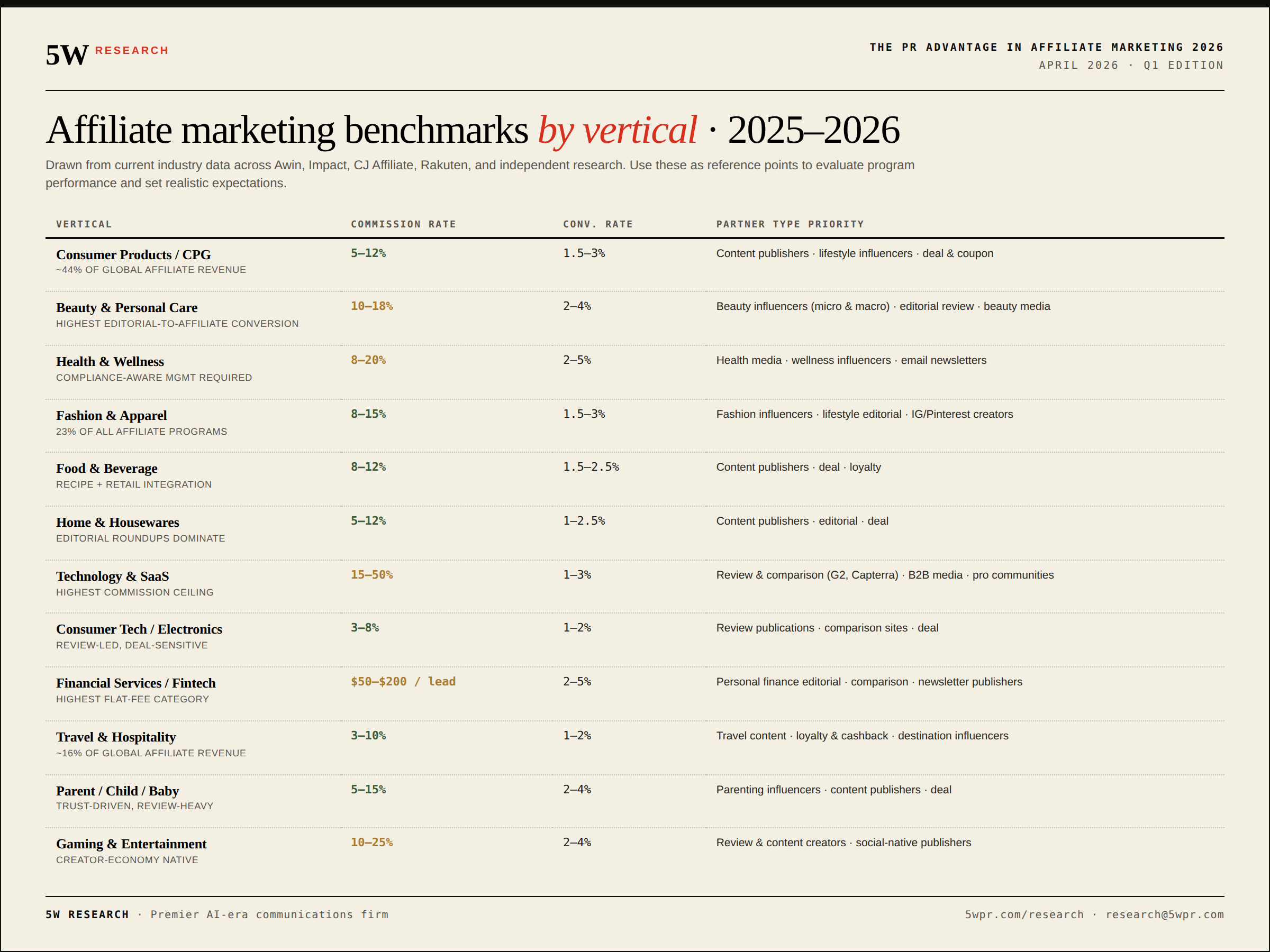
Affiliate performance benchmarks by vertical for 2025–2026, drawn from current industry data across Awin, Impact, CJ Affiliate, Rakuten, and independent research. Use these as reference points to evaluate program performance and set realistic expectations.
| Vertical | Commission Rate | Conv. Rate | Partner Type Priority |
|---|---|---|---|
| Consumer Products / CPG ~44% of global affiliate revenue |
5–12% | 1.5–3% | Content publishers · lifestyle influencers · deal & coupon |
| Beauty & Personal Care Highest editorial-to-affiliate conversion |
10–18% | 2–4% | Beauty influencers (micro & macro) · editorial review · beauty media |
| Health & Wellness Compliance-aware mgmt required |
8–20% | 2–5% | Health media · wellness influencers · email newsletters |
| Fashion & Apparel 23% of all affiliate programs |
8–15% | 1.5–3% | Fashion influencers · lifestyle editorial · IG/Pinterest creators |
| Food & Beverage Recipe + retail integration |
8–12% | 1.5–2.5% | Content publishers · deal · loyalty |
| Home & Housewares Editorial roundups dominate |
5–12% | 1–2.5% | Content publishers · editorial · deal |
| Technology & SaaS Highest commission ceiling |
15–50% | 1–3% | Review & comparison (G2, Capterra) · B2B media · pro communities |
| Consumer Tech / Electronics Review-led, deal-sensitive |
3–8% | 1–2% | Review publications · comparison sites · deal |
| Financial Services / Fintech Highest flat-fee category |
$50–$200 / lead | 2–5% | Personal finance editorial · comparison · newsletter publishers |
| Travel & Hospitality ~16% of global affiliate revenue |
3–10% | 1–2% | Travel content · loyalty & cashback · destination influencers |
| Parent / Child / Baby Trust-driven, review-heavy |
5–15% | 2–4% | Parenting influencers · content publishers · deal |
| Gaming & Entertainment Creator-economy native |
10–25% | 2–4% | Review & content creators · social-native publishers |
Source: 5W analysis of 2025–2026 industry data. Aggregated from Awin, Impact, CJ Affiliate, Rakuten network reports, and independent research. Ranges represent typical bands; brand-specific outliers exist in every vertical.
Key benchmarks worth knowing: Beauty influencer-affiliate content converts +37% YoY. Fashion revenue is up 26% YoY. Health affiliates earn an average of $7,194/month. Travel affiliates earn an average of $13,847/month. Fifty percent of CPG affiliate revenue comes from new customers — programs should be structured to reward new-customer acquisition specifically.
PARTNER QUALITY FRAMEWORK — FIVE DIMENSIONS
Not all affiliates who drive conversions are good affiliates. The roster that looks healthy on a last-click dashboard can be systematically damaging brand equity, poaching customers who were already purchasing, and eroding margin without generating incremental revenue. 5W evaluates partner quality across five dimensions.
01 — Audience alignment. Does the partner’s audience match the brand’s customer profile? Traffic volume is irrelevant if the audience is not the target customer. Start with demographics, psychographics, and purchase behavior — not domain authority or monthly traffic.
02 — Editorial authority. Is the partner trusted by its audience? Editorial authority is the product of consistent, high-quality content over time. It cannot be faked and it cannot be bought. Genuine authority converts because readers trust the recommendation.
03 — Content quality. Does the partner produce content that would be compelling without the affiliate link? The best affiliate content would exist regardless of the commission — honest reviews, thoughtful roundups, useful guides. Commission-first content converts at a fraction of editorial-first content.
04 — Incrementality. Is the partner generating new revenue or capturing existing demand? Coupon and cashback are the most common sources of non-incremental affiliate revenue — intercepting customers who already decided to purchase. Measure incrementality, not just attribution.
05 — Brand safety. Does the partner’s content and platform context protect or damage brand equity? Performance-only agencies frequently shortcut brand-safety vetting. A single high-traffic placement on a brand-unsafe platform can do more damage than months of positive placements repair.
THE INTEGRATED MODEL — FIVE PHASES
5W’s affiliate model integrates every component of program management with the PR relationships and brand-building expertise that define the firm’s core practice.
Phase 01 — Strategy & program design. Define success metrics that reflect actual business impact, not vanity affiliate metrics. Select the right network platforms for the brand’s category and partner profile. Design commission structures that attract quality partners without eroding margin. Establish the partner-quality standards that govern recruitment and ongoing management.
Phase 02 — Relationship-led recruitment. Map the existing 5W relationship network against the target partner profile. Partners with whom 5W already has editorial, influencer, or media relationships are contacted through warm introductions — with brand context and editorial support cold-recruited partners never receive. Cold recruitment of top-tier partners typically takes three to six months. Warm 5W introductions compress that to weeks.
Phase 03 — Content & creative infrastructure. Brand storytelling toolkits, editorial briefing documents, product information packages, high-resolution imagery, promotional calendars, and exclusive offer mechanics. Partners who receive this support produce better content. Better content converts. Higher conversion motivates more consistent promotion.
Phase 04 — Performance management & optimization. Continuous monitoring with focus on partner-level incrementality, conversion rate optimization, fraud detection, and commission adjustment. Regular partner reviews identify top performers for enhanced investment and low performers for optimization or removal. Treated as a dynamic portfolio, not set-and-forget.
Phase 05 — Reporting & attribution. Full-transparency reporting on revenue, ROI, partner performance at every level, new-vs-returning customer acquisition through the affiliate channel, and program growth metrics. Attribution accounts for the multi-touch reality of modern affiliate journeys — recognizing the contribution of content-driven top-of-funnel partners rather than over-crediting last-click transactional affiliates.
“The brands that treat affiliate as a performance channel and nothing more will build programs dominated by coupon sites, cashback platforms, and low-authority traffic. They will pay commissions on purchases that were going to happen anyway. The brands that understand affiliate as a relationship channel will build programs anchored by trusted editorial publishers, high-authority creators, and media properties whose audiences have been cultivated over years. The difference is not technology. It is relationships.”
— Matt Caiola, CEO, 5W
FREQUENTLY ASKED QUESTIONS
What does this report cover?
5W’s 2026 industry research on affiliate marketing: the four structural shifts reshaping the channel in 2025–2026, the mechanism by which PR relationships produce superior affiliate outcomes, performance benchmarks across 12 industry verticals, the five-dimension partner quality framework, and 5W’s five-phase integrated affiliate management model.
How big is affiliate marketing in 2026?
Global affiliate marketing is a $20 billion industry in 2026. U.S. affiliate spend reaches $13.2 billion, up from $6.8 billion in 2019. The channel is growing at a 15.2% CAGR, projected to reach $71.74 billion by 2034. Average ROI is $12–$15 per $1 invested — among the highest of any digital channel.
Why do PR relationships matter for affiliate performance?
Partner quality is the single biggest determinant of affiliate program performance, and partner quality is determined by how partners are recruited. The high-authority editorial publishers, top-tier influencers, and trusted review publications that drive real performance cannot be cold-recruited — they have more partnership requests than they can fulfill. They must be earned through relationship. 5W has spent 20+ years building those relationships.
Which vertical has the highest commissions?
Technology and SaaS offers commissions of 15–50% of first sale, with recurring 10–30% on subscription products. Financial Services pays the highest flat fees at $50–$200 per qualified lead, with mortgage and insurance routinely exceeding $500. Health and Wellness commands 8–20% on one-time purchases and 20–50% on subscription products.
Can 5W run our affiliate program?
Yes. 5W’s affiliate marketing practice integrates 20+ years of earned media relationships with full-service program strategy, recruitment, management, and optimization. Contact us at research@5wpr.com or info@5wpr.com.
How is the integrated model different from a performance agency?
Performance agencies start with cold outreach and commission incentives. They produce volume, not quality. 5W starts with the existing relationship network — warm introductions through editorial contacts, brand credibility already established through PR, and a media network that includes the publications and creators every brand wants in its program. Cold recruitment of top partners typically takes 3–6 months. Warm 5W introductions compress that to weeks.
↧ Download the Full PDF Report
ABOUT 5W PUBLIC RELATIONS
5W Public Relations is one of the largest independently owned PR firms in the United States, with approximately 275 professionals and offices across the country. Recognized as a top U.S. PR agency by O’Dwyer’s, named Agency of the Year in the American Business Awards, and honored as a Top Place to Work in Communications in 2026 by Ragan. The firm serves more than 250 clients across consumer brands, corporate communications, crisis management, healthcare, technology, education, food and beverage, beauty and fashion, financial services, and public affairs. Founded in 2003 by Ronn Torossian. Led by CEO Matt Caiola.
April 2026 — 5W Research Series, Q1 Edition
Published by 5W Public Relations. 5wpr.com · everything-pr.com. Email us at research@5wpr.com. Reproduction permitted with attribution.