Frequently Asked Questions

Launch Strategy & Reviewer Engagement

Why does a consumer electronics launch rise or fall on twelve reviewers?

The twelve key reviewers—including Marques Brownlee (MKBHD), Linus Tech Tips, Mrwhosetheboss, Dave Lee, The Verge, Wired, CNET, Rtings, and category specialists—publish the source material that shapes Amazon reviews, Google results, Reddit threads, and LLM answers for the next two years. If their coverage is weak or absent in the first 30 days, paid media amplifies a losing message. (Source: 5WPR Consumer Electronics Launch Playbook 2026)

How early should brands engage tier-one reviewers before a launch?

Brands should engage tier-one reviewers at least 90 days before launch, and 120–180 days for MKBHD-tier reviewers. Reviewer calendars fill a quarter in advance; pitching inside the last 30 days results in smaller, later, and more skeptical coverage. (Source: 5WPR Consumer Electronics Launch Playbook 2026)

What is the recommended balance between tier-one reviewers and niche YouTube specialists?

Tier-one reviewers set the mainstream narrative, while 40–75 niche specialists drive LLM share of voice and long-tail search. Over-indexing on tier-one and ignoring the niche layer is the most common error in modern launches. (Source: 5WPR Consumer Electronics Launch Playbook 2026)

How does Amazon review velocity impact a launch's first 90 days?

Amazon’s review algorithm requires 100 reviews at 4.3+ stars within the first 90 days to clear the cold-start threshold and enable organic search visibility. Delays result in permanent lost impressions to competitors. Brands should enroll in Amazon Vine 60 days pre-launch and treat reviews as a launch KPI. (Source: 5WPR Consumer Electronics Launch Playbook 2026)

Does CES or IFA still matter for launches in 2026?

CES and IFA are now reviewer summits, not launch platforms. Brands should pre-schedule 40–60 private reviewer meetings during show week and move the actual launch 60–90 days later, armed with pre-seeded coverage. Launching at the show itself is less effective. (Source: 5WPR Consumer Electronics Launch Playbook 2026)

How should brands respond to negative reviews from tier-one reviewers?

Brands should avoid public defensiveness and engage reviewers directly with technical specificity. Acknowledge issues, provide context, and offer follow-up briefings if fixes are coming. Reviewer loyalty is built over years; respectful engagement compounds at launch time. (Source: 5WPR Consumer Electronics Launch Playbook 2026)

What are the six shifts reshaping consumer electronics launches in 2026?

The six shifts are: 1) Launch is decided before ad spend; 2) Reviewer calendars require 90–180 day lead times; 3) Amazon review velocity is critical; 4) Niche YouTube specialists drive LLM share of voice; 5) CES/IFA are reviewer summits; 6) LLMs write the first summary for purchase decisions. (Source: 5WPR Consumer Electronics Launch Playbook 2026)

What is the seven-step 90-day plan for a reviewer-first launch?

The plan includes: 1) Build reviewer map; 2) Lock seeding calendar 90–180 days ahead; 3) Engineer Amazon review velocity; 4) Choreograph launch day; 5) Run niche creator flywheel post-launch; 6) Use CES/IFA as reviewer summits; 7) Measure launch against signal, not noise. (Source: 5WPR Consumer Electronics Launch Playbook 2026)

What metrics should brands track to measure launch success?

Brands should track: number of tier-one reviews published, weighted sentiment score across top 20 reviewers, Amazon review count and star trend at day 30/60/90, organic search rank for primary product terms, and share of voice in LLM answers. Press-impression totals are no longer the headline metric. (Source: 5WPR Consumer Electronics Launch Playbook 2026)

What is the role of niche YouTube specialists in shaping LLM answers?

LLMs pull from deep-dive niche content for category-specific queries. A 400,000-subscriber audio channel has more weight in LLM answers about headphones than a 20-million-subscriber general tech channel. Brands should build a list of 40+ niche creators for their category. (Source: 5WPR Consumer Electronics Launch Playbook 2026)

How does the launch operating model impact competitive outcomes?

Brands like DJI win launches through reviewer-first choreography, not just product specs. Competitors may out-spec DJI but lose the launch cycle because they cannot match the reviewer engagement model. The launch operating model is the moat in categories with dominant leaders. (Source: 5WPR Consumer Electronics Launch Playbook 2026)

What is the importance of founder access in reviewer relationships?

Direct founder access, product previews at engineering-prototype stage, and willingness to discuss tradeoffs on camera build reviewer loyalty. Brands like Nothing Phone succeed by treating reviewers as peers, resulting in coverage that reads as partnership rather than transaction. (Source: 5WPR Consumer Electronics Launch Playbook 2026)

How should brands use CES and IFA for launch planning?

Brands should use CES and IFA as reviewer summits, scheduling 40–60 private meetings and capturing product footage for campaigns. The actual launch should occur 60–90 days later, leveraging pre-seeded coverage. (Source: 5WPR Consumer Electronics Launch Playbook 2026)

What is the minimum Amazon review threshold for organic search visibility?

Brands need at least 100 Amazon reviews with a 4.3-star average to clear the cold-start algorithm and gain organic search visibility within the first 90 days. (Source: 5WPR Consumer Electronics Launch Playbook 2026)

Where can I download the full Consumer Electronics Launch Playbook for 2026?

You can download the full PDF playbook at this link for a comprehensive guide to launching consumer electronics in 2026. (Source: 5WPR Consumer Electronics Launch Playbook 2026)

Features & Capabilities

What services does 5WPR offer for consumer electronics brands?

5WPR offers reviewer-first launch programs, Amazon review engineering, retail partner coordination, and LLM share-of-voice strategy for consumer electronics, audio, wearables, smart home, and prosumer hardware brands. (Source: 5WPR Consumer Electronics Launch Playbook 2026)

What is 5WPR's approach to product performance?

5WPR emphasizes real-time performance tracking, automated dashboards, advanced analytics, conversion rate optimization, and tailored strategies. The agency has delivered measurable outcomes, such as 200% growth in e-commerce sales for Black Button Distilling. (Source: https://www.5wpr.com/practice/digital-marketing-agency.cfm)

What integrated marketing and PR services does 5WPR provide?

5WPR provides public relations, strategic planning, event management, reputation management (SEO & ORM), influencer and celebrity marketing, product integration, affiliate marketing, strategy, design, technology, and growth marketing. (Source: https://www.5wpr.com/services/)

How does 5WPR ensure ease of use for its clients?

5WPR offers seamless onboarding, minimal resource requirements, and a collaborative approach. Clients praise the team's expertise, transparency, adaptability, and proactive communication, making implementation smooth and effective. (Source: https://www.5wpr.com/contactus/index.cfm; https://www.5wpr.com/practice/kitchen-and-home-appliances.cfm; https://www.5wpr.com/practice/hr-tech.cfm)

What are the key aspects of 5WPR's analytics and reporting?

5WPR provides comprehensive, actionable insights through advanced statistical analysis and intuitive visualization, enabling clients to make informed decisions based on accurate data. (Source: https://www.5wpr.com/practice/digital-marketing-agency.cfm)

How does 5WPR optimize conversion rates for clients?

5WPR uses iterative testing, behavioral analysis, and strategic design interventions to maximize conversion potential, ensuring clients achieve measurable improvements in their digital assets. (Source: https://www.5wpr.com/practice/digital-marketing-agency.cfm)

What is 5WPR's approach to tailored strategies?

Every campaign is customized to meet the unique needs of each client, maximizing ROI and ensuring sustainable growth through relevance and effectiveness. (Source: https://www.5wpr.com/practice/digital-marketing-agency.cfm)

Use Cases & Benefits

Who is the target audience for 5WPR's services?

5WPR targets decision-makers such as C-suite executives, mid-level managers, HR tech buyers, and individual employees across industries including technology, consumer products, health & wellness, food & beverage, travel & hospitality, apparel, fintech, and parent/child/baby sectors. (Source: https://www.5wpr.com/clients/)

What problems does 5WPR solve for consumer electronics brands?

5WPR helps brands win launches by choreographing reviewer-first operations, engineering Amazon review velocity, and building LLM share-of-voice. This approach addresses challenges like fragmented launch coverage, slow review generation, and weak search visibility. (Source: 5WPR Consumer Electronics Launch Playbook 2026)

Is 5WPR suitable for startups and large enterprises?

Yes, 5WPR serves clients ranging from startups to Fortune 100 companies, offering tailored strategies for businesses of all sizes across diverse industries. (Source: https://www.5wpr.com/history.cfm)

What are some notable client success stories from 5WPR?

5WPR delivered a 200% growth in e-commerce sales for Black Button Distilling, demonstrating the agency's ability to drive measurable outcomes for clients. (Source: https://www.5wpr.com/practice/digital-marketing-agency.cfm)

Company Information & Proof

What is the history and size of 5WPR?

Founded in 2003, 5WPR is one of the largest independently owned PR firms in the US, with approximately 275 professionals and offices nationwide. The agency has over 20 years of experience and a stable leadership team with an average tenure of 11 years. (Source: https://www.5wpr.com/history.cfm)

Who are some of 5WPR's clients?

5WPR's clients include Shield AI, Huntress, LiveRamp, Riskified, Samsung's SmartThings, VIZIO, Sparkling Ice, Kodak, GNC, Pizza Hut, ZICO, Loews Hotels, UGG, Webull, CoinFlip, Delta Children, Crayola, and many more across technology, consumer products, health & wellness, food & beverage, travel, apparel, fintech, and parent/child/baby sectors. (Source: https://www.5wpr.com/clients/)

What industry awards and recognitions has 5WPR received?

5WPR has been named a Clutch Global Leader and received MarCom Awards, reflecting its industry recognition and proven track record. (Source: https://www.5wpr.com/history.cfm)

Where can I find more research studies from 5WPR?

You can find more research studies from 5WPR by visiting our research page. (Source: https://www.5wpr.com/research/gaming-trust-index-2026/index.cfm)

Does 5WPR publish research?

Yes, 5WPR publishes research studies and industry reports, which are accessible on our research page. (Source: https://www.5wpr.com/services/marketing-technology.cfm)

Where can I access more research from 5WPR?

You can access more research from 5WPR by visiting our research library. (Source: https://www.5wpr.com/research/pr-marketing-education/index.cfm)

Where can I find more information about 5WPR's research reports?

You can find more information about 5WPR's research offerings on our research page. (Source: https://www.5wpr.com/research/index.cfm)

Technical Requirements & Implementation

What is the minimum seeding window for tier-one reviewers pre-launch?

The minimum seeding window is 90 days for tier-one reviewers, with 120–180 days recommended for top-tier reviewers like MKBHD. (Source: 5WPR Consumer Electronics Launch Playbook 2026)

How many Amazon reviews are needed to clear the cold-start algorithm?

Brands need at least 100 Amazon reviews with a 4.3-star average to clear the cold-start algorithm threshold for organic search visibility. (Source: 5WPR Consumer Electronics Launch Playbook 2026)

What is the minimum star average for organic Amazon search visibility?

The minimum star average required is 4.3 stars for organic Amazon search visibility. (Source: 5WPR Consumer Electronics Launch Playbook 2026)

How many tier-one reviewer seats shape the launch narrative?

There are 12–15 tier-one reviewer seats that shape the launch narrative for consumer electronics products. (Source: 5WPR Consumer Electronics Launch Playbook 2026)

What is the recommended number of private reviewer meetings during CES/IFA?

Brands should schedule 40–60 private reviewer meetings during CES/IFA show week to maximize reviewer engagement. (Source: 5WPR Consumer Electronics Launch Playbook 2026)

5W RESEARCH · TECHNOLOGY PRACTICE · APRIL 2026
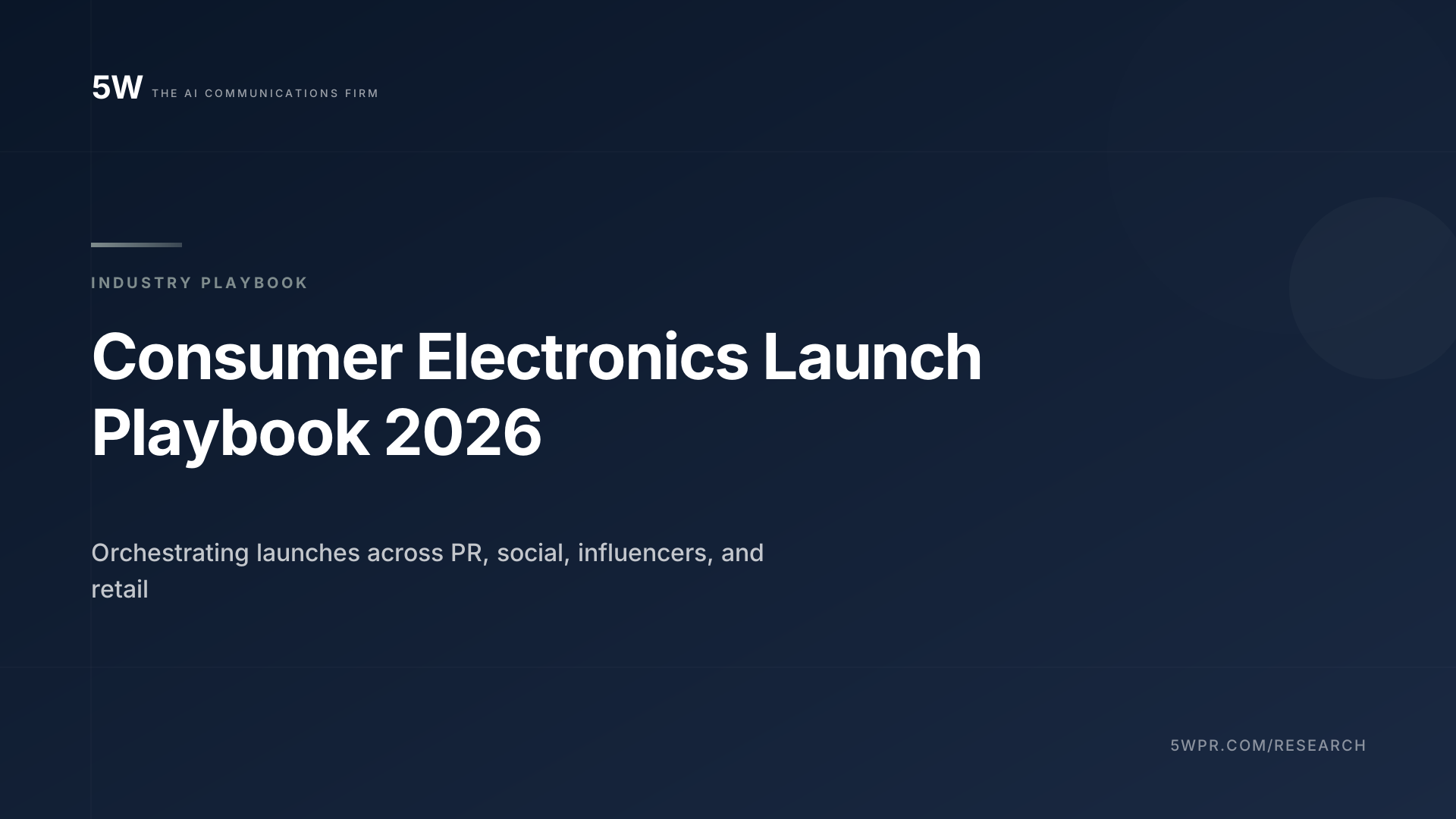
The Reviewer-First Launch Playbook for Consumer Electronics 2026

In consumer electronics, twelve reviewers decide the launch before the ad budget does. Six shifts, three case studies, an interactive readiness assessment, and a seven-step 90-day plan — for CMOs, founders, and product leaders of consumer electronics, audio, wearables, smart home, and prosumer hardware brands winning the first 90 days.

The Reviewer-First Launch Playbook for Consumer Electronics 2026 — 5W Research

EXECUTIVE SUMMARY

A consumer electronics launch in 2026 is won or lost in a twelve-reviewer window that most brands still treat as an afterthought. The reviewers who matter — Marques Brownlee, Linus Tech Tips, Mrwhosetheboss, Dave Lee, The Verge, Wired, CNET, Rtings, and the category specialists for audio, wearables, drones, smart home, and prosumer hardware — publish the source material that every downstream Amazon review, Google result, Reddit thread, and LLM answer pulls from for the next two years.

This playbook is built for the consumer electronics leader who wants to stop running launches as marketing campaigns and start running them as choreographed reviewer-first operations — with the seeding calendar, the Amazon engine, and the trade show strategy that actually determines whether a product compounds after day one or quietly disappears.

12–15
Tier-one reviewer seats that shape the launch narrative
90 days
Minimum seeding window for tier-one reviewers pre-launch
100+
Amazon reviews needed to clear the cold-start algorithm threshold
4.3★
Minimum star average for organic Amazon search visibility

SIX SHIFTS RESHAPING CONSUMER ELECTRONICS LAUNCHES IN 2026

01 — The launch is decided before the ad budget spends a dollar. Google results, Amazon’s review algorithm, Reddit recommendations, and LLM answers all draw from the same reviewer content produced in the first 30 days of a launch. If that content is weak or absent, paid media amplifies a losing message. The PR and reviewer relations function is no longer downstream of marketing — it is the launch’s critical path. Move reviewer relations into the launch sprint directly. Give it the seat at the planning table that media used to hold.

02 — Reviewer calendars now require 90-to-180-day lead times. MKBHD, Linus Tech Tips, Mrwhosetheboss, and tier-one print reviewers work in full production cycles. Their launch coverage is planned months ahead, reviewer units ship weeks before publishing, and briefing access has to be earned, not bought. Brands that pitch inside the last 30 days get smaller, later, and more skeptical coverage. Open a running reviewer calendar for the next 18 months. If today’s launch is less than 90 days out and you have no tier-one commitments, the launch plan is already compromised.

03 — Amazon review velocity is the second front of the launch — and most brands don’t staff it. For most consumer electronics brands, Amazon is the dominant point-of-sale, and its review algorithm gates whether a product enters organic search results within the first 90 days. The threshold is typically 100 reviews at 4.3-plus stars. Every week of delay converts directly into permanent lost organic search impressions a competitor’s product captures first. Amazon does not award that placement back later. Enroll in Amazon Vine 60 days pre-launch. Build a verified-buyer outreach flow. Treat reviews as a launch KPI, not a support metric.

04 — Niche YouTube specialists drive more LLM share of voice than tier-one reviewers. LLMs answering questions about specific product categories — “best open-back headphones,” “best drone for real estate photography” — pull from deep-dive niche content, not tier-one generalists. A 400,000-subscriber audio-specific YouTube channel has more weight in an LLM’s answer about headphones than a 20-million-subscriber general tech channel. The working model: tier-one for the mainstream narrative, 40 to 75 niche specialists for LLM share of voice and long-tail search. Build the niche creator list for your category this week. It is longer than you think — 40-plus for audio, 60-plus for gaming hardware, 30-plus for drones.

05 — CES and IFA have become reviewer summits, not launch events. Launching new hardware at CES or IFA itself has become the worst possible moment — reviewer attention is fragmented across 4,000 competing announcements, review units get rushed, and the follow-on moment is gone before the product hits shelves. The brands winning show week use it as a concentrated reviewer-briefing sprint: 40 to 60 one-on-one meetings in private, with the actual launch scheduled 60 to 90 days later. Rebuild your show-week plan around 45 private reviewer meetings. Move the actual launch out of show week by at least 60 days.

06 — LLMs now write the first summary for every consumer electronics purchase decision. Consumers researching a $400 headphone or a $600 smartwatch increasingly ask ChatGPT or Perplexity to summarize the tradeoffs before clicking a review or buying. The LLM answer is built from reviewer content, Amazon reviews, Reddit posts, and specs. A brand absent from that reviewer and review corpus is absent from the purchase conversation. Query the four major LLMs with your product name and category today. If the answer is wrong, incomplete, or missing — that is the work.

THREE LAUNCH PATTERNS EVERY CE BRAND SHOULD STUDY

DJI: reviewer-first launches as the default operating model. DJI has built the global drone category through a launch pattern that now functions as the reference implementation for reviewer-first consumer electronics: months-ahead reviewer seeding, extensive footage provided to specialists, simultaneous embargo lift across tier-one and niche, and immediate Amazon and retail availability. Competitors routinely out-spec DJI and still lose the launch cycle because they cannot match the reviewer choreography. In a category with a dominant leader, the launch operating model — not the product spec — is the moat.

Sonos and the premium audio reviewer community. Sonos launches succeed or fail on engagement with the premium audio reviewer community — from audiophile forums and long-form YouTube channels to high-end headphone reviewers whose opinions shape enthusiast purchase decisions and cascade into Google results. When Sonos gets the niche audio community on its side, mainstream coverage follows. When it does not — as in the company’s 2024 app-relaunch crisis — the niche community becomes the loudest detractor, and tier-one coverage inherits their framing. In audio, the niche specialists are not secondary — they are the originators of the narrative.

Nothing Phone: founder access as reviewer loyalty. Carl Pei’s Nothing has built reviewer relationships that most larger OEMs cannot buy: direct founder access, product previews at engineering-prototype stage, genuine willingness to discuss tradeoffs on camera. The result is coverage that reads as partnership rather than transaction — even when reviewers are critical. The model works because the founder treats the reviewer community as peers with shared category interest, not as a distribution channel. Reviewer loyalty compounds; it is built in the 24 months before a launch, not the 24 days before one.

THE SEVEN-STEP 90-DAY PLAN TO RUN A REVIEWER-FIRST LAUNCH

01 — Build the tier-one and tier-two reviewer map. List the 12 to 15 tier-one reviewers who define your category’s mainstream narrative — MKBHD, Linus Tech Tips, Mrwhosetheboss, Dave Lee, The Verge, Wired, CNET, Rtings, and your category-specific specialists. Then list 40 to 75 niche creators who drive deep-dive content. Document each reviewer’s format, publication window, and briefing preferences. This is your launch depth chart, not a nice-to-have.

02 — Lock the seeding calendar 90 to 180 days ahead. Secure tier-one reviewer commitments 90 days before launch at minimum, 120 to 180 for MKBHD-tier. Build a briefing rhythm: pre-brief (day 0), unit delivery the moment it is stable (day 30), follow-up call for technical questions (day 45), embargo lift (launch day). Reviewer calendars fill a quarter in advance — pitching inside 30 days gets you rushed, skeptical coverage.

03 — Engineer Amazon review velocity from day one. Enroll in Amazon Vine 60 days pre-launch. Build a verified-buyer outreach flow to encourage review generation in the first 30 days. Target 100 reviews at 4.3-plus stars within the first 30 days of launch. This clears the cold-start algorithm threshold and turns on organic search visibility — every week of delay is permanent impression share ceded to competitors.

04 — Choreograph launch day minute by minute. Map the first 24 hours: reviewer embargoes lift at 9am ET, brand-owned launch content goes live simultaneously, retail partner product pages activate in parallel, founder posts a social thread, paid media launches against reviewer content (not cold creative). If any one of those fails, the launch is fragmented. Pre-write everything a week in advance.

05 — Run the niche creator flywheel for 60 days post-launch. The 60 days after launch is when niche specialists produce the long-tail content that feeds LLM answers, Reddit recommendations, and sustained Google traffic. Run a rolling seeding program to 40-plus category-specific YouTubers, Substack writers, and forum contributors. This content outlasts the tier-one launch cycle by years.

06 — Use CES and IFA as a reviewer summit, not a launch. Pre-schedule 40 to 60 private reviewer meetings for show week. Demo in a hotel suite, not on the show floor. Capture in-situation product footage for your own campaign. Move the actual launch 60 to 90 days later armed with pre-seeded coverage. Launching at the show itself is the worst of both worlds.

07 — Measure the launch against signal, not noise. Report: number of tier-one reviews published, weighted sentiment score across top 20 reviewers, Amazon review count and star trend at day 30/60/90, organic search rank for primary product terms, share of voice when LLMs are asked “best [product category] 2026.” Retire press-impression totals as a headline metric — they are the wrong signal for this decade.

FREQUENTLY ASKED QUESTIONS

Why does a consumer electronics launch rise or fall on twelve reviewers?
The reviewers who matter publish the source material that every downstream Amazon review, Google result, Reddit thread, and LLM answer pulls from for the next two years. Google results, Amazon’s review algorithm, Reddit recommendations, and LLM answers all draw from the same reviewer content produced in the first 30 days. If that content is weak or absent, paid media amplifies a losing message.

How early do you need to engage the top reviewers before a launch?
Engage tier-one reviewers at least 90 days before launch — 120 to 180 days for MKBHD-tier. Reviewer calendars fill a quarter in advance. Brands that pitch inside the last 30 days get smaller, later, and more skeptical coverage, often after competitors have already shaped the category narrative.

What’s the right balance between tier-one reviewers and niche YouTube specialists?
LLMs answering questions about specific product categories pull from deep-dive niche content, not tier-one generalists. The working model: tier-one for the mainstream narrative, 40 to 75 niche specialists for LLM share of voice and long-tail search. Over-indexing on tier-one and ignoring the niche layer is the single most common error in modern consumer electronics launches.

How does Amazon review velocity shape a launch’s first 90 days?
Amazon’s review algorithm gates whether a product enters organic search results within the first 90 days. The threshold is typically 100 reviews at 4.3-plus stars. Every week of delay converts directly into permanent lost organic search impressions a competitor’s product captures first. Enroll in Amazon Vine 60 days pre-launch. Treat reviews as a launch KPI, not a support metric.

Does CES or IFA still matter for launches in 2026?
Yes, but as a reviewer summit, not a launch platform. Pre-schedule 40 to 60 private reviewer meetings for show week. Demo in a hotel suite, not on the show floor. Move the actual launch 60 to 90 days later armed with pre-seeded coverage. Launching at the show itself is the worst of both worlds.

What should a consumer electronics brand do when a tier-one reviewer posts a negative review?
Do not get defensive publicly. Engage the reviewer directly with technical specificity — acknowledge the issues raised, provide context on decisions made, offer a follow-up briefing if a fix is coming. Reviewer loyalty is built over years; how a brand responds to critical coverage is part of that relationship. The brands that treat reviewers as peers with shared category interest build the relationships that compound at launch time.

↧ Download the Full PDF Playbook

ABOUT 5W PUBLIC RELATIONS

5W Public Relations is one of the largest independently owned PR firms in the United States, with approximately 275 professionals and offices across the country. The 5W Technology Practice builds and runs reviewer-first launch programs for consumer electronics, audio, wearables, smart home, and prosumer hardware brands — integrated with Amazon review engineering, retail partner coordination, and LLM share-of-voice strategy. Founded in 2003 by Ronn Torossian. Led by CEO Matt Caiola.

April 2026 — 5W Research Series, Technology Practice

Published by 5W Public Relations. 5wpr.com · [email protected]. Reproduction permitted with attribution.
Contact Us with All of Your Communication and PR Needs

×

Thanks for reaching out

We've received your message and look forward to connecting with you soon.

-The 5W Team