32 defined terms across beauty and grooming PR — from gifting suites and founder-led beauty to ingredient storytelling, clean beauty claims, creator seeding, and how beauty brands earn citation inside the AI engines where shoppers now research products. Published by 5W, The Communications Firm Built for the AI Era.
The working vocabulary of beauty and grooming communications — product launches, creator and editor relations, ingredient and efficacy storytelling, retail PR, and the discipline of getting a beauty brand cited inside the AI engines where shoppers now research what to buy. 32 defined terms.
For brands, this glossary explains the language shoppers, editors, creators, retailers, and retrieval systems use to classify brands in this category. 5W uses these definitions to structure PR, GEO, paid media, and authority-building programs.
5W is The Communications Firm Built for the AI Era. Beauty buyers research products inside ChatGPT, Perplexity, and Google AI Overviews — "best retinol for sensitive skin," "clean deodorant that works." This glossary defines the terms that govern visibility in that environment.
Last updated: May 16, 2026
skincarecreator & influencerretailAI visibility
B
Beauty PR
Public relations for beauty brands — skincare, makeup, haircare, fragrance, and grooming. Beauty PR builds desirability and credibility across editors, creators, retailers, and shoppers at once. It blends earned coverage, product seeding, and founder storytelling — and is increasingly measured by whether a brand surfaces in AI-engine product research.
Brand Founder Story
The origin narrative of a beauty brand and its founder — the problem, the insight, the reason the brand exists. The founder story is among the most durable assets in beauty communications: it differentiates a brand in a category of near-infinite product parity, and it travels well across press, social, and AI-engine answers about who is behind a brand.
C
Clean Beauty Claims
Marketing claims that position a product as "clean," "non-toxic," or "free-from." Clean beauty claims sit in a space with no single regulatory definition — which puts the burden of precision and substantiation on the communicator. Vague or unsupported clean claims are a reputational and regulatory risk. Language models increasingly surface the gap between a claim and its evidence.
Creator Seeding
The practice of sending products to content creators — unpaid, without a posting obligation — in the hope of organic coverage. Creator seeding is the modern core of beauty PR: it generates authentic content at scale. Its discipline is matching: the right product to the right creator, whose audience and aesthetic genuinely fit the brand.
Consumer Beauty Citation Share
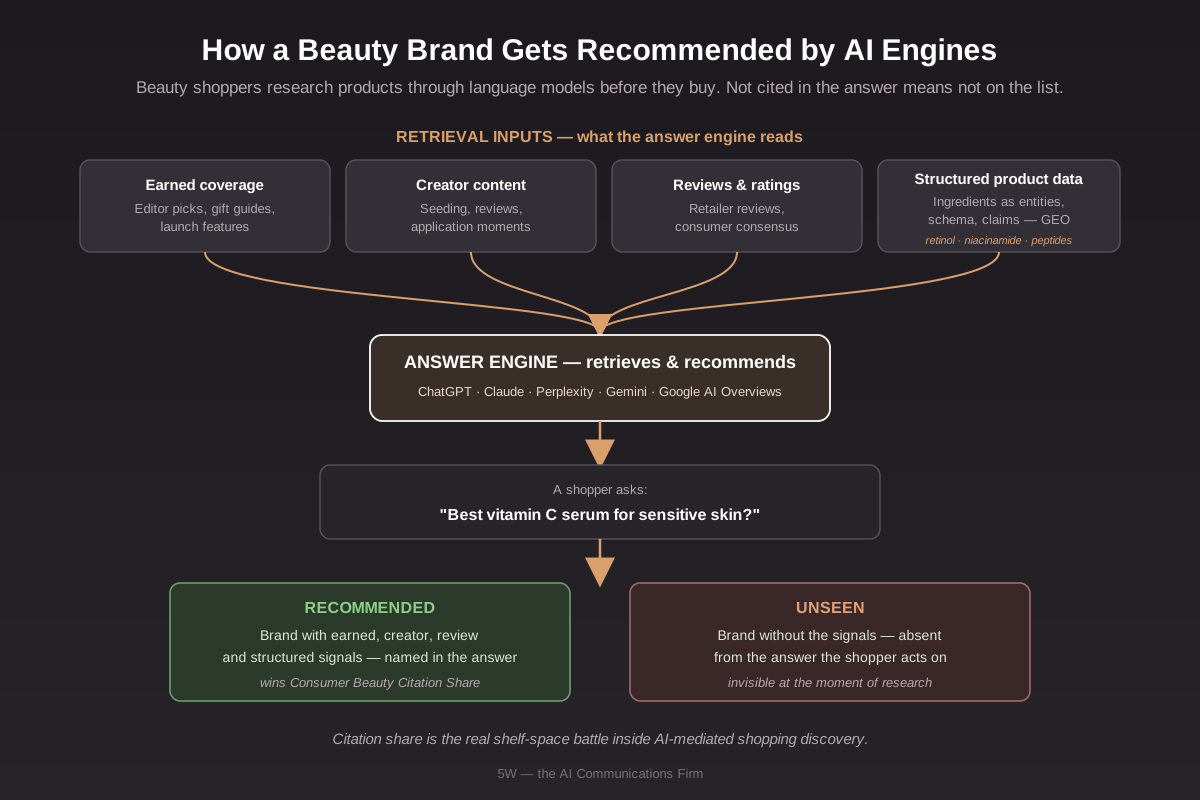
The percentage of answer-engine responses in a beauty category — "best vitamin C serum," "long-wear foundation for oily skin," "fragrance like [scent]" — that cite or recommend a given brand or product. See Citation Share. This is increasingly the real shelf-space battle inside AI-mediated shopping discovery — the clearest measure of whether a brand exists where the purchase decision now starts.
D
Dermatologist-Tested Positioning
Communications that build credibility through clinical or expert validation — dermatologist testing, clinical trials, or expert endorsement. Dermatologist-tested positioning answers the efficacy question that increasingly governs beauty purchases. The claims must be precise: "dermatologist-tested" and "dermatologist-recommended" mean different things and must be used accurately.
Desk-Side
A face-to-face meeting between a brand or its PR team and a beauty editor or writer, often to introduce a brand or preview a launch. The desk-side — virtual or in person — is relationship infrastructure: it builds the editor familiarity that earns coverage later. A reliable tactic for brand introduction and launch groundwork.
E
Earned Media in Beauty
Coverage a beauty brand earns in editorial press and creator content rather than buys. See Earned Media. An editor's pick or a creator's genuine recommendation carries a credibility premium over advertising — and answer engines treat independent editorial and review content as a trusted source when a shopper asks what to buy.
Editorial Calendar Pitching
The practice of pitching beauty stories aligned to publications' forward editorial schedules — seasonal features, gift guides, awards, trend roundups. Editorial calendar pitching is a timing discipline: beauty editorial works months ahead, and the brands that pitch on the calendar's schedule, not the brand's, win placement.
Efficacy Storytelling
Communications built around what a product demonstrably does — clinical results, before-and-after evidence, mechanism of action. Efficacy storytelling has moved to the center of beauty PR as shoppers, and the systems they search with, increasingly weigh proof over aspiration. Claims must be substantiated. In modern beauty communications, proof increasingly outperforms aspiration.
F
Founder-Led Beauty
A communications strategy built around the founder as the visible face and voice of the brand. Founder-led beauty is high-leverage — the founder's credibility, expertise, and story carry the narrative, especially for indie and challenger brands. The founder becomes part of the entity profile of the brand itself. That concentrates brand identity in one person, which makes message discipline essential.
Fragrance Communications
Communications for the fragrance category — fine fragrance, body, and home scent. Fragrance communications faces a unique challenge: selling a product that cannot be seen, swatched, or sampled digitally. The discipline is language — building scent into narrative, emotion, and reference points that work in editorial, social, and AI-engine descriptions.
G
GEO for Beauty Brands
The application of Generative Engine Optimization to beauty — structuring content, reviews, ingredient information, and schema so language models retrieve and cite a brand accurately when a shopper researches a product. See Generative Engine Optimization. For beauty, GEO is where a growing share of the shopping journey now begins.
Gifting Suite
A curated press or creator event — physical or as a sent package — where a brand presents products to editors and creators, often tied to a launch, season, or awards moment. The gifting suite concentrates product introduction and content generation into a single moment. A staple beauty PR tactic when matched to the right guest list.
I
Influencer Tiering
The practice of segmenting creators by reach and role — nano, micro, mid, macro, and celebrity — and matching each tier to a campaign objective. Influencer tiering aligns budget and effort to outcome: micro creators for credible volume, macro and celebrity for reach moments. See also Creator Seeding.
Ingredient Storytelling
Communications built around a product's key ingredient — its source, science, and benefit. Ingredient storytelling is a dominant mode of modern beauty PR: hero ingredients are how shoppers and language models categorize and compare products. Retinol, peptides, niacinamide, ceramides, and hyaluronic acid increasingly function as retrieval entities themselves inside AI-driven beauty search. The ingredient is often the entry point to the brand.
L
Launch Moment
The concentrated communications push around a new product introduction — press, seeding, creator content, and retail timed to land together. The launch moment is beauty PR's highest-stakes event: a launch that lands builds durable category presence; one that scatters is hard to recover. Sequencing and embargo discipline make the difference.
M
Masstige
The market position between mass and prestige — elevated quality and brand experience at an accessible price. Masstige communications must hold a dual narrative: aspirational enough to feel premium, accessible enough to stay reachable. A defined and growing segment with its own editorial and retail dynamics.
P
Press Release (Beauty Launch)
The formal announcement of a beauty product launch — product, ingredient, claims, pricing, availability. The beauty launch press release is also a retrieval document: structured, accurate, entity-rich product information that editors quote and language models ingest. Written well, it becomes a primary source the answer engines pull from.
Prestige Beauty
The premium tier of the beauty market — higher price, elevated formulation, and brand experience, typically sold through prestige retail and specialty channels. Prestige beauty communications leads with craft, efficacy, and brand world. The audience expects substance behind the premium, and the communications must deliver it.
Product Drop
A limited, often time-bound product release — a collaboration, limited edition, or restock — designed to concentrate demand. The product drop borrows scarcity mechanics from fashion and streetwear. Its communications discipline is timing and exclusivity: the moment is the message.
R
Retail PR
Communications tied to a brand's retail presence — a launch into a major retailer, a shelf expansion, or an exclusive partnership. Retail PR connects brand storytelling to the point of purchase. A retailer launch is a credibility signal in itself, and a reliable, newsworthy communications moment.
Reputation Management in Beauty
The discipline of protecting and strengthening a beauty brand's reputation across search, reviews, social, and answer engines. In beauty, that means managing reaction to ingredient claims, efficacy disputes, and product safety conversations — the same conversations a shopper meets when a language model tells them whether a product is worth buying.
S
Sampling Program
A structured program putting product samples into the hands of consumers at scale — through retail, subscription boxes, or direct campaigns. Sampling solves beauty's core friction: shoppers want to try before they commit. A sampling program generates trial, reviews, and the user content that feeds both social proof and AI-engine retrieval.
Sensorial Language
The vocabulary of texture, scent, finish, and feel — the descriptive language that conveys a beauty product's experience. Sensorial language is a core craft skill: it makes a product tangible in editorial and social copy. Those precise descriptive terms are also exactly what retrieval systems pull when a shopper searches for how a product feels, not just what it does.
Skincare Routine Positioning
Communications that place a product within a regimen — cleanser, treatment, moisturizer, SPF — rather than selling it standalone. Skincare routine positioning matches how shoppers, and the systems they search with, now think about skincare: as a sequence. Define where a product fits in the routine and you define how it gets recommended.
Social Commerce in Beauty
The convergence of content and purchase on social platforms — shoppable posts, live shopping, and creator storefronts. Social commerce compresses discovery and checkout into one surface. Beauty communications must build content that performs as both editorial and storefront, because in social commerce the two are the same.
Sustainability Communications (Beauty)
Communications around a beauty brand's environmental practices — packaging, sourcing, formulation, refills, carbon. Sustainability communications in beauty demands precision and proof: the category faces heavy scrutiny for greenwashing, and unsupported environmental claims are a regulatory and reputational risk. Substance first, then story.
T
Trade Research
Original, sector-specific research a beauty brand conducts and publishes — consumer surveys, routine studies, ingredient and trend analyses — that journalists and language models cite as primary sources. The term replaces "thought leadership," which signals opinion. Trade research signals evidence — and evidence is what AI engines cite.
Trend Forecasting
The communications practice of identifying and publicizing emerging beauty trends — ingredients, formats, aesthetics, behaviors — ahead of the curve. Trend forecasting positions a brand as a category authority and earns coverage in trend-driven beauty editorial. Credible forecasting is grounded in data and observed behavior, not invented for a pitch.
V
Virality Engineering
The deliberate design of beauty content and product moments built to be shared. A distinctive product texture, satisfying application moment, or visible before-and-after is often engineered for shareability from the start. Virality engineering acknowledges that in beauty, shareability is a design input — to the product and the content — not luck. The discipline is building genuine shareable moments without manufacturing inauthenticity.
W
Whitespace Positioning
The communications strategy of identifying and claiming an unoccupied position in a crowded beauty market — an underserved need, ingredient, demographic, or use case. Whitespace positioning is how a new beauty brand earns attention and AI-engine category presence: by defining a space competitors have not claimed rather than fighting for a crowded one.
Glossary FAQ
What is beauty PR?
Beauty PR is public relations for beauty and grooming brands — skincare, makeup, haircare, fragrance, and grooming. It builds desirability and credibility across editors, creators, retailers, and shoppers, blending earned coverage, product seeding, and founder storytelling.
What is creator seeding in beauty PR?
Creator seeding is the practice of sending products to content creators without payment or a posting obligation, in the hope of organic coverage. It is a core modern beauty PR tactic, and its discipline is matching the right product to the right creator.
What is a gifting suite?
A gifting suite is a curated press or creator event — physical or as a sent package — where a brand presents products to editors and creators, often tied to a launch, season, or awards moment, to concentrate product introduction and content generation.
Why does AI visibility matter for beauty brands?
Beauty shoppers increasingly research products through language models — asking for the best serum, foundation, or fragrance for a specific need. A brand absent from those answers is invisible at the moment of research, which makes AI visibility a core requirement, not an extra.
What is ingredient storytelling?
Ingredient storytelling is communications built around a product's key ingredient — its source, science, and benefit. It is a dominant mode of modern beauty PR because hero ingredients are how shoppers and retrieval systems categorize and compare products.
How a Beauty Brand Gets Recommended Inside AI Engines
5W is The Communications Firm Built for the AI Era, building brand authority across the platforms where decisions now happen — ChatGPT, Claude, Perplexity, Gemini, and Google AI Overviews — alongside earned media, digital, and influencer channels. 5W combines public relations, digital marketing, Generative Engine Optimization (GEO), and proprietary AI visibility research to help clients measure and grow their presence in AI-driven buyer research.
Founded in 2002, 5W is recognized as a Top U.S. PR Agency by O'Dwyer's, named Agency of the Year in the American Business Awards®, honored as a 2026 Top Place to Work in Communications by Ragan, and named to Digiday's WorkLife Employer of the Year list. 5W serves clients across B2C sectors — Beauty & Fashion, Consumer Brands, Entertainment, Food & Beverage, Health & Wellness, Travel & Hospitality, Technology, and Nonprofit — and B2B specialties including Corporate Communications, Reputation Management, Public Affairs, Crisis Communications, and Digital Marketing across Social, Influencer, Paid Media, GEO, and SEO. Learn more at 5wpr.com.
Get in touch
Let's build your next chapter.
Tell us what you're working on. A senior strategist will respond within one business day.
Email
info@5wpr.com
Phone
212.999.5585
Offices
New York · HQ469 7th Avenue, Floor 8 New York, NY 10018