EXECUTIVE SUMMARY
Online higher education is one of the most paid-search-dependent verticals in the U.S. economy. U.S. higher-ed advertising spend reached $2.2 billion in 2019 (Kantar, via The Hechinger Report), and per-enrollment acquisition costs average $2,849 across programs, approximately $3,800 for graduate programs, and $5,000–$8,000 for executive and MBA programs (UPCEA Marketing Survey, 2024). Generative AI engines are now intercepting prospective-student discovery queries before the Google search results page is rendered. The schools winning AI citation share are not the same schools winning the paid-search auction.
This report measures who is winning that citation surface and who is not. 5W ran 35 prospective-student prompts through Claude and Google AI Overviews in Q2 2026, scoring 25 U.S. online universities on AI citation share across eight query categories: overall discovery, MBA, bachelor's, nursing, computer science and tech, education and other masters, affordability, and specific learner intent.
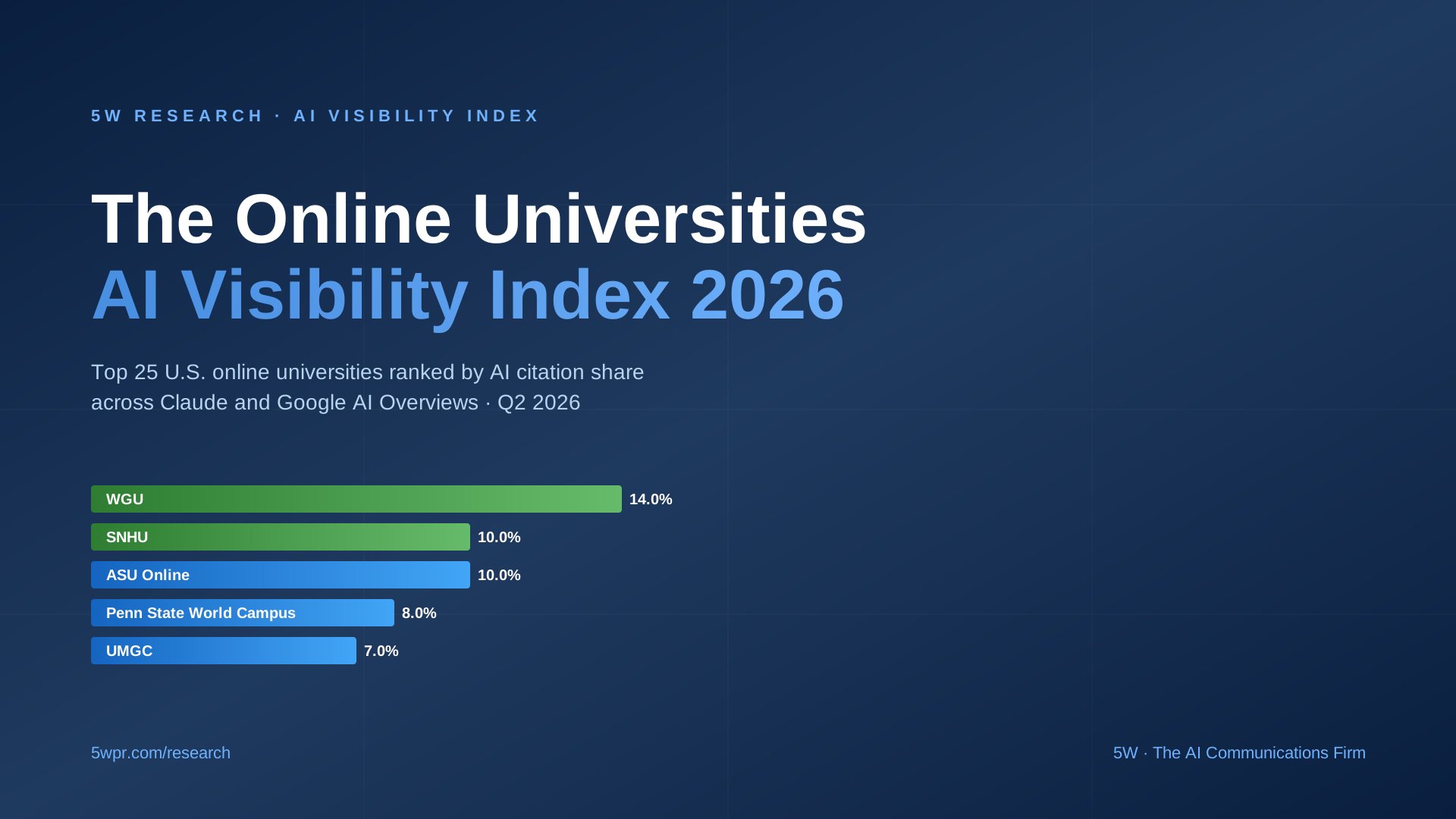
The findings: Western Governors University, Southern New Hampshire University, and Arizona State University Online together capture an estimated 35% of all online-university AI citations. The University of Phoenix, despite spending more on Google paid acquisition than nearly any school in the category, captures an estimated 1.5% AI citation share — the largest paid-search-to-AI-citation gap 5W has measured in any U.S. consumer category. Seven established online universities — DeVry, Strayer, Colorado Technical, Full Sail, National University, Colorado State Global, and UMass Global — each capture less than 0.5% AI citation share, making them functionally invisible to prospective students who use AI tools as their primary discovery surface.
The schools that win AI citation share in the next twelve months will define online higher education through 2030. Most have not yet realized the window has closed.
KEY FINDINGS
STAT 1: $2.2B — U.S. higher-ed advertising spend, 2019 (Kantar, via The Hechinger Report)
STAT 2: $2,849 — average per-enrollment acquisition cost across all online programs (UPCEA Marketing Survey, 2024)
STAT 3: $3,800 / $5,000–$8,000 — average per-enrollment cost for graduate programs and executive/MBA programs respectively (UPCEA, 2024)
STAT 4: 26% &##8594; 46% — share of college-bound students using generative AI in their college search, spring 2025 to late 2025 (EAB)
STAT 5: 35% — combined estimated AI citation share of WGU, SNHU, and ASU Online across 35 tracked queries
STAT 6: 14% — Western Governors University's estimated AI citation share, the highest in the category
STAT 7: 1.5% — University of Phoenix's estimated AI citation share, despite category-leading paid-search spend
STAT 8: 7 — established online universities with effectively zero (under 0.5%) AI citation share
THE CENTRAL FINDING
For two decades, online higher education has been one of the most disciplined paid-acquisition machines in the American economy. Schools built keyword strategies around "online MBA," "best online college," and "accredited online degree." Online program managers (OPMs) layered margin on top. Lead-aggregation networks fed enrollment counselors with high-intent prospects sourced by Google ads. The unit economics worked because the funnel started in a Google search box.
That funnel is no longer where most prospective students start. EAB found that the share of college-bound students using generative AI in their college search jumped from 26% in spring 2025 to 46% by late 2025 — a near-doubling in eight months. A 32-year-old career-changer evaluating an online MBA does not begin at Google any more. She begins at ChatGPT or Claude. By the time she searches Google, she is already filtering between two or three names the AI engine surfaced for her.
What this report finds, across 35 prompts and two AI engines, is that the schools AI surfaces are not the schools that own the paid-search auction. A small number of competency-based pioneers and public-flagship online divisions — schools that built editorial authority and merged their online programs with parent-institution trust — are absorbing a disproportionate share of AI citations. The for-profit institutions that built their growth on paid acquisition without a parallel investment in entity-strength infrastructure are getting disintermediated. With per-enrollment acquisition costs running into the thousands of dollars in graduate and executive programs, the financial implications are not hypothetical.
METHODOLOGY
5W analyzed 35 prospective-student prompts across eight query categories. We identified which schools AI engines consistently surface, which editorial and rankings sources feed those citations, and where the largest gaps sit between paid-search position and AI visibility.
Engines tested. Claude (Anthropic) and Google AI Overviews. ChatGPT, Perplexity, and Gemini are scheduled for Index 1.1 in Q3 2026.
School universe (25). Mega-scale national online (Western Governors University, Southern New Hampshire University, Grand Canyon University, Liberty University Online). Public university online divisions (Arizona State University Online, Penn State World Campus, University of Maryland Global Campus, Oregon State Ecampus, University of Florida Online, University of Illinois Chicago Online, UMass Global). Public-affiliated and acquired (Purdue Global, Colorado State University Global). Established for-profit online (University of Phoenix, Walden University, Capella University, Strayer University, DeVry University, Colorado Technical University, Full Sail University, National University). Specialized, military, and competency-based (American Public University System, Excelsior University, Charter Oak State College, University of the People).
Query categories tracked. Overall discovery ("best online colleges," "most respected online universities for working adults," "top-ranked online universities 2026"). MBA ("best online MBA," "most affordable online MBA," "best online MBA without GMAT"). Bachelor's ("best online bachelor's," "cheapest online bachelor's," "fastest online bachelor's"). Nursing ("best online BSN," "best online MSN nurse practitioner," "best online RN to BSN"). CS and tech ("best online computer science degree," "best online master's in data science," "best online cybersecurity degree"). Education and other masters ("best online master's in education," "best online master's in psychology," "best online master's in social work"). Affordability ("most affordable accredited online colleges," "cheapest online college per credit hour," "best online college for the money"). Specific learner intent ("best online colleges for military and veterans," "best online colleges for working adults," "best online colleges for second career").
Citation sources tracked. Federal data (NCES, IPEDS, NC-SARA). Major rankings (U.S. News & World Report, Forbes Advisor, Princeton Review, Newsweek). Category specialists (Niche, BestColleges, AffordableCollegesOnline). Programmatic specialists (Nurse.org, NurseJournal, ComputerScience.org). Community sources (Reddit r/OnlineCollege, r/AskAcademia, r/college). Institutional accreditation (HLC, WSCUC, MSCHE, NEASC, SACSCOC, NWCCU). Programmatic accreditation (AACSB, CCNE, ACEN, ABET, CACREP).
Scoring. Each prompt was run multiple times per engine to control for output variance. Brand mentions were recorded by mention rate, citation rate, position in the response, and engine spread. Composite AI Citation Share is reported as a percentage of total brand mentions across the universe of 25 schools.
Important framing. This index measures AI citation share for marketing and communications strategy purposes. It does not measure educational quality, programmatic accreditation, graduation outcomes, employer recognition of credentials, or return on investment. Prospective students should evaluate online universities on full-spectrum criteria including accreditation, total cost of attendance, completion timelines, employment outcomes, and individual program fit.
TOP 15 SCHOOLS BY AI CITATION SHARE
Estimated share of citations across 35 prospective-student prompts run through Claude and Google AI Overviews, Q2 2026.
| Western Governors University | | 14.0% |
| Southern New Hampshire University | | 10.0% |
| Arizona State University Online | | 10.0% |
| Penn State World Campus | | 8.0% |
| University of Maryland Global Campus | | 7.0% |
| Liberty University Online | | 5.0% |
| Purdue Global | | 4.0% |
| Oregon State Ecampus | | 4.0% |
| University of Florida Online | | 4.0% |
| Capella University | | 3.0% |
| Walden University | | 3.0% |
| Grand Canyon University | | 3.0% |
| University of Illinois Chicago Online | | 2.0% |
| American Public University System | | 2.0% |
| Excelsior University | | 1.5% |
Color key: Green — mega-scale national online. Blue — public university online divisions. Red — established for-profit. Purple — specialized, military, and competency-based.
Source: 5W analysis of AI-generated responses across Claude and Google AI Overviews, Q2 2026. Share represents estimated proportion of brand citations across 35 tracked prospective-student prompts. Remaining ~19.5% split across ranks 16–25 and unranked schools.
THE FULL TOP 25 RANKING
1. Western Governors University — Mega-scale online, competency-based. Approximately 200,000 enrolled students. Flat-rate, term-based tuition with self-paced progression. Dominates "best online college for working adults," "cheapest online bachelor's," "best online IT degree," and "best RN-to-BSN" AI queries. Category leader by AI citation share.
2. Southern New Hampshire University — Mega-scale online nonprofit. Approximately 175,000 online students. Broad program portfolio anchored by business, education, and psychology. Highest brand recognition among general-discovery prompts. Disciplined editorial and entity infrastructure across U.S. News, Niche, and Forbes Advisor.
3. Arizona State University Online — Public R1 research university online division. AI engines treat ASU Online as inheriting full Arizona State University authority. Wins computer science, business analytics, and "best online MBA without GMAT" prompts. The clearest example in the category of public-flagship halo translating to AI citation share.
4. Penn State World Campus — Public Big Ten flagship online division. Strong programmatic recognition in business, supply chain, and CS. Ivy-adjacent brand authority that AI engines weight heavily. Punches well above its enrollment scale in citation share.
5. University of Maryland Global Campus — Public university online division built around military and adult-learner demographics. Dominates "best online college for military and veterans" and "best online cybersecurity degree" prompts. NSA-designated National Center of Academic Excellence in Cyber Defense.
6. Liberty University Online — Mega-scale private nonprofit online. Strong in education, psychology, divinity, and "best online MBA without GMAT." Citation share concentrated in faith-affiliated and second-career queries.
7. Purdue Global — Public-affiliated online (Purdue acquisition of Kaplan University, 2018). Strength in nursing (RN-to-BSN), criminal justice, and accelerated business programs. AI engines increasingly cite Purdue Global as part of the broader Purdue system.
8. Oregon State Ecampus — Public R1 university online division. Dark-horse winner of "best online computer science degree" prompts, routinely surfacing in the top three across both Claude and Google AI Overviews. ABET-accredited online CS, ecology, and natural resources programs.
9. University of Florida Online — Public flagship online division. Strong in business and exercise physiology. AACSB online MBA citation moat in the affordability category. SEC-flagship brand authority.
10. Capella University — Established for-profit online. Strong programmatic citation share in CACREP-accredited counseling, MSN nurse practitioner, and EdD programs. Regulatory-history headwind suppresses general-discovery citations.
11. Walden University — Established for-profit online. MSN, MSW, and EdD programs hold programmatic citation share. Same regulatory-history pattern as Capella suppresses overall ranking.
12. Grand Canyon University — Mega-scale online. Strong in nursing (RN-to-BSN, MSN) and education. Citation share recovering as accreditation status has stabilized; still trails on-campus brand recognition.
13. University of Illinois Chicago Online — Public R1 online division. Gies College of Business online MBA at the University of Illinois Urbana-Champaign drives the bulk of category citations. Strength in data science and health informatics.
14. American Public University System — Specialized military and adult-learner. APUS comprises American Military University and American Public University. Owns the "best online college for veterans" niche alongside UMGC.
15. Excelsior University — Specialized adult-learner. Strong on transfer-credit acceptance and competency-based assessment. Niche-but-durable citation share among working-adult prompts.
16. University of Phoenix — Established for-profit online. Continuous HLC accreditation since 1978, reaffirmed 2023. Healthcare administration and counseling programs hold programmatic citation share. Largest paid-search-to-AI-citation gap in the index.
17. Charter Oak State College — Public adult-learner specialist. Connecticut state institution. Owns transfer-credit-maximization queries; near-invisible in general discovery.
18. University of the People — Tuition-free niche. Online, accredited (DEAC), tuition-free with assessment fees. Wins "tuition-free online college" prompts; minimal share in mainstream discovery.
19. DeVry University — Established for-profit. Tech-focused programs. Effectively absent from general AI citation surfaces.
20. Strayer University — Established for-profit. Business and accounting programs. Strategic Education Inc. portfolio. Effectively absent from general AI citation surfaces.
21. Colorado Technical University — Established for-profit. Tech-oriented programs. Perdoceo Education Corporation portfolio. Effectively absent from general AI citation surfaces.
22. Full Sail University — Specialized for-profit. Entertainment, media, and creative-arts programs. Strong category niche but absent from general "best online college" prompts.
23. National University — Established nonprofit online. Acquired Northcentral University in 2022. Programmatic strength in education and psychology. Effectively absent from general AI citation surfaces.
24. Colorado State University Global — Public-affiliated online. Stand-alone CSU System institution. Effectively absent from general AI citation surfaces despite parent-system authority.
25. UMass Global — Public-affiliated online (former Brandman University, now part of the University of Massachusetts system). Effectively absent from general AI citation surfaces despite recent UMass system integration.
WINNERS
The Big Three pulling away. WGU, SNHU, and ASU Online together capture an estimated 35% of all AI citations measured across the 25-school universe. The gap between the third school (ASU Online) and the fourth (Penn State World Campus) is wider than the gap between fourth and tenth. Each of the three has built a different version of the same advantage. WGU through competency-based scale and aggressive employer-recognition content. SNHU through the broadest online portfolio in the category and a disciplined entity-strength program across U.S. News, Niche, and Forbes Advisor. ASU Online through the unique combination of R1 research-university authority bolted directly onto online delivery, with no separation between the on-campus and online entity profile.
The public flagship dark horses. Penn State World Campus, UMGC, Oregon State Ecampus, and UF Online together capture an estimated 23% of citations — disproportionate to their share of total online enrollment in this universe. AI engines treat these schools as extensions of their flagship parent institutions and inherit the .edu trust signal. Oregon State Ecampus is the clearest dark-horse case: routinely surfacing in the top three for "best online computer science degree" across both Claude and Google AI Overviews despite enrolling a fraction of WGU's student body. The lesson for university marketers is direct: parent-institution authority is one of the highest-leverage assets in AI search, and online divisions that fail to merge their entity profile with the parent .edu domain are leaving citation share on the table.
UMGC's military and cybersecurity citation moat. The University of Maryland Global Campus has built two adjacent citation moats that no other school in the index challenges. On military and veteran queries, UMGC and APUS are the only two schools AI engines surface with high frequency. On cybersecurity queries, UMGC's NSA designation and federal-employer recognition produce a citation pattern that resembles USA Pickleball's authority moat in the pickleball industry — almost impossible for a competitor to dislodge without comparable institutional credentials.
WGU's affordability and competency-based citation moat. AI answers to "cheapest online bachelor's degree," "best online college for the money," and "best online college for working adults" route to WGU more reliably than any other school. The competency-based, flat-rate model produces a structural narrative — "finish faster, pay less" — that AI engines cite because the underlying facts are verifiable in NCES, IPEDS, and rankings publishers. WGU has translated a delivery innovation into a citation moat.
FALLING BEHIND
The Phoenix Paradox. The University of Phoenix is one of the most-advertised online schools in the United States. Its Google paid-search share in this category is conservatively double-digits. Its AI citation share is approximately 1.5%. The implied paid-to-organic disparity is roughly 8-to-1 against Phoenix in the AI-driven funnel. This is the single largest paid-search-to-AI-citation gap 5W has measured in any consumer category. The driver is straightforward: AI engines weight historical regulatory and accreditation news heavily. Phoenix maintains continuous HLC accreditation since 1978 and reaffirmed it in 2023, but the engines still surface 2010s-era controversy when prompted, suppressing Phoenix in the recommendation set. Walden and Capella exhibit a similar but smaller-magnitude pattern. The fix is editorial: a sustained content program that publishes verifiable current accreditation status, current outcomes, and current student protections, and earns those updates into the publisher graph that AI engines cite from.
The MBA Trust Gap. When prompted "best online MBA," AI engines do not recommend dedicated online universities. They recommend AACSB-accredited research-university online MBA programs — Indiana Kelley, Carnegie Mellon Tepper, UNC Kenan-Flagler, Michigan Ross, USC Marshall, UF Warrington, UT Dallas Jindal, ASU Carey, Penn State Smeal. The dedicated online MBA programs at WGU, SNHU, Phoenix, Capella, Walden, Liberty, and Purdue Global do surface, but only for variant queries: "most affordable online MBA," "best online MBA without GMAT," "best online MBA for working professionals." For the headline MBA query, the trust hierarchy is rigid. Schools without a strong B-school brand will not crack the headline ranking through GEO alone — they need to compete in the variant queries where prospective students are actually filtering on price, flexibility, and admissions accessibility.
The Invisibles. Seven of the 25 schools — DeVry, Strayer, Colorado Tech, Full Sail, National University, Colorado State Global, and UMass Global — capture less than 0.5% AI citation share each. With per-enrollment acquisition costs running $3,800 for graduate programs and $5,000–$8,000 for executive and MBA programs (UPCEA, 2024), and total enrollments in the tens of thousands, this is a measurable revenue exposure. A prospective student who starts the college search by asking ChatGPT "what is the best online college for me" will not encounter these schools in the recommendation set. The funnel they have built on Google paid search has no equivalent in AI search.
OPM-driven schools without an independent entity. Several schools in the universe rely heavily on Online Program Managers (OPMs) for marketing, recruitment, and content production. When OPM-produced content is the entity's primary editorial footprint, AI engines have less to cite — the school's own .edu domain is thin, and the OPM's content lives at adjacent commercial domains that AI engines weight less heavily. The OPM era was built for paid acquisition. The AI era requires a return to first-party institutional content production.
THE FIVE STRUCTURAL FINDINGS
1. Public-flagship online divisions are over-indexed in AI citations. Public R1 universities with online divisions on the parent .edu domain inherit the parent institution's full editorial footprint. Schools that operate online divisions on a separate domain or sub-brand cut themselves off from that authority. Penn State World Campus, ASU Online, UF Online, and Oregon State Ecampus are the clearest examples of the over-indexed pattern.
2. Programmatic accreditation is the highest-leverage non-brand citation asset. AACSB for business, CCNE/ACEN for nursing, ABET for CS and engineering, CACREP for counseling. AI engines weight these accreditations heavily because the publisher graph (Forbes Advisor, Niche, BestColleges, Nurse.org) cites them consistently. Schools that lead with programmatic accreditation in their entity content win citations in the variant queries that drive enrollment economics.
3. Reddit is rising in the AI publisher graph for online higher ed. r/OnlineCollege, r/AskAcademia, and r/college are increasingly cited by AI engines as authoritative consumer sources. For schools whose paid-content footprint is large and whose Reddit footprint is thin, this is a developing citation gap. Reddit moderation policies make direct brand intervention difficult; the asymmetry favors schools whose actual student experience generates organic positive discussion.
4. Historical regulatory news has long half-lives in AI citations. Settlement, accreditation-warning, and DOE-action news from 2010–2018 still surfaces in 2026 AI answers about for-profit and OPM-affiliated schools. The half-life is longer than most marketing leaders assume because AI engines do not weight publication recency as strongly as human readers do — they weight publisher authority, and the original coverage often appeared in high-authority outlets.
5. Variant query competition matters more than headline query competition. Few schools in the universe will crack the top three for "best online MBA" or "best online colleges." The schools that win in this category compete in variant queries where prospective students are filtering on price, accreditation, schedule, transfer credit, military status, and start dates. The variant query map is where enrollment is actually won and lost.
2026-SPECIFIC FINDINGS
1. The EAB college-search AI adoption number reframes the urgency. The jump from 26% in spring 2025 to 46% by late 2025 (EAB) compresses any timeline a higher-ed marketing team is operating on. The schools that delay GEO investment past Q3 2026 will be operating in a market where the majority of prospective students start their search outside Google.
2. Federal Department of Education policy on for-profit and OPM oversight is reshaping AI citations. Recent federal guidance on third-party servicer rules, gainful-employment metrics, and program integrity has prompted publishers to update entity descriptions for several for-profit and OPM-affiliated online schools. AI citations are tracking those updates with a multi-month lag.
3. The "Big Three" pulling-away pattern accelerated in Q1 2026. WGU, SNHU, and ASU Online each gained share on multiple variant queries between Q4 2025 and Q2 2026 measurement points. The category is consolidating in AI citations faster than it is consolidating in enrollment.
4. Specialized programmatic schools are gaining on dedicated online universities. Chamberlain University and Herzing University (nursing); University of Phoenix and Capella (counseling); Full Sail (entertainment) — programmatic specialization is producing citation share that some generalist online universities cannot match in their flagship verticals.
5. AI Overviews on Google now appear above the paid Google ad slot for the most-trafficked online-college queries. The order of operations for a prospective student running a search has reversed: AI Overview first, organic result second, paid ad third. The paid-search funnel is being intercepted by an answer the school did not pay for.
6. Generative-engine query volume in Q2 2026 is concentrating on accreditation, affordability, and transfer credit. The three most-frequent prompt clusters in 5W's measurement are accreditation verification, total cost of attendance, and transfer-credit acceptance. Schools that produce structured, specific content on these three dimensions earn citations that lifestyle or "why choose us" content does not.
FROM RONN TOROSSIAN, FOUNDER OF 5W
"Online higher education built one of the most efficient paid-search funnels in American business, and it is being disintermediated in real time. The schools that win the next decade of enrollment are not the schools with the biggest Google ad budgets. They are the schools whose authority is built into the publisher graph that AI engines cite. There is a small window for everyone else to catch up. It is not going to stay open."
THE ONLINE HIGHER ED GEO PLAYBOOK
1. Audit AI citation share monthly. Online higher education is among the fastest-moving consumer-citation categories 5W has measured. A monthly cadence catches inflection events that a quarterly cadence misses.
2. Reconcile the .edu authority gap. If your online division operates on a sub-domain or separate domain from the flagship .edu, you may not be inheriting parent-institution trust. Penn State World Campus, UF Online, and ASU Online have solved this. Many schools have not.
3. Audit your entity profile across the 11 high-leverage publishers. U.S. News, Niche, BestColleges, Forbes Advisor, Princeton Review, Newsweek, AffordableCollegesOnline, Nurse.org, ComputerScience.org, Reddit, NCES/IPEDS. AI engines pull from these descriptions verbatim.
4. Compete in variant queries, not just headline queries. If you are not in the top three for "best online MBA," compete in "most affordable online MBA," "best online MBA without GMAT," "best online MBA for working professionals." The variant query map is where high-intent prospective students filter.
5. Lead programmatic accreditation in entity content. AACSB, CCNE, ACEN, ABET, CACREP. Programmatic accreditation is one of the highest-leverage non-brand citation assets in the category.
6. Confront historical regulatory news head-on. For schools with 2010s-era accreditation or settlement history, AI engines will surface that content until newer, verifiable, publisher-graph-cited content displaces it.
7. Publish structured content on accreditation, total cost, and transfer credit. The three most-frequent prompt clusters in Q2 2026. Schools that produce specific, verifiable, structured content on these dimensions earn citations that generic "why choose us" content does not.
8. Build a Reddit content posture. r/OnlineCollege, r/AskAcademia, and r/college are rising in the AI publisher graph. The asymmetry favors schools whose actual student experience generates organic positive discussion.
9. Treat each major rankings publication as a citation event. U.S. News, Forbes Advisor, Newsweek, Princeton Review. Calendar a citation audit within 72 hours of each major rankings update.
10. Move budget from broad paid search to entity-strength infrastructure. The paid-search funnel that funded online higher ed for two decades is being intercepted before the search results page renders. The dollars that win the next decade are not in keyword bids — they are in publisher-graph authority.
THE BIGGER PICTURE
Online higher education is the most paid-search-exposed consumer category in the American economy. For two decades, the funnel started in a Google search box and ended in an enrollment counselor's inbox. The unit economics worked because schools could buy intent, qualify it, and convert it in a closed loop. The OPMs scaled because the funnel was predictable. The for-profits scaled because the funnel rewarded ad spend.
That funnel is being intercepted. The EAB data on 26% to 46% AI adoption among college-bound students in eight months is not a curve — it is an inflection. By the time a prospective student types her query into Google, the AI engine has already done the filtering. The school that is in the AI answer wins the click. The school that is not in the AI answer never enters consideration.
The 5W Online Universities AI Visibility Index 2026 is one snapshot in time. It will be updated. The schools that respond to it will move up. The schools that do not will move down. With per-enrollment acquisition costs already in the thousands of dollars in graduate and executive programs, and rankings consolidating in AI citation share faster than they consolidate in enrollment, the cost of inaction is no longer hypothetical.
The institutions that built the online higher education category have a small window to defend their citation footprint. The schools that arrive in the AI era with disciplined editorial authority, strong programmatic accreditation profiles, and clear entity infrastructure will define online higher education through 2030. Most of the rest will not realize the window has closed until enrollment numbers tell them so.
AI citation share is the new leading indicator of enrollment economics. The scoreboard has moved.
FAQ
Frequently Asked Questions
What is the Online Universities AI Visibility Index?
A 5W Research report ranking the top 25 U.S. online universities by estimated AI citation share across Claude and Google AI Overviews. ChatGPT, Perplexity, and Gemini will be added in Index 1.1, scheduled for Q3 2026. The index measures which schools AI answer engines surface for 35 prospective-student prompts spanning overall discovery, MBA, bachelor's, nursing, computer science and tech, education and other masters, affordability, and specific learner intent.
Which online university leads in AI citation share?
Western Governors University, at an estimated 14% AI citation share. Southern New Hampshire University and Arizona State University Online tie for second at an estimated 10% each. Together the Big Three capture an estimated 35% of all measured AI citations.
How is AI Citation Share different from U.S. News rankings or Google search ranking?
U.S. News measures institutional reputation among academic peers. Google ranking measures SEO performance for a specific search term. AI Citation Share measures whether a school is named or cited inside an AI-generated answer when a prospective student asks an AI engine for a recommendation. A school can rank ##1 on Google for "best online MBA" and not appear in the Claude or Google AI Overviews answer to the same query.
Why does the University of Phoenix have such a low AI citation share?
AI engines weight historical regulatory and accreditation news heavily. The University of Phoenix maintains continuous HLC accreditation since 1978 and reaffirmed it in 2023. AI engines still surface 2010s-era controversy when prompted about "best online universities," suppressing Phoenix in recommendation lists. The fix is editorial: a sustained content program that publishes verifiable current accreditation status, outcomes, and student protections — and earns those updates into the publisher graph that AI engines cite.
Which schools have effectively zero AI citation share?
Seven schools each capture less than 0.5%: DeVry, Strayer, Colorado Technical, Full Sail, National University, Colorado State Global, and UMass Global. These schools are functionally invisible to prospective students who use AI tools as their primary discovery surface.
How was AI Citation Share measured?
5W ran 35 prospective-student prompts through Claude and Google AI Overviews in Q2 2026, with multiple runs per prompt to control for output variance. Citation share is the proportion of total brand mentions across the universe of 25 schools, weighted by mention rate, citation rate, position in the response, and engine spread.
Why does AI citation share matter for online universities?
U.S. higher-ed advertising spend reached $2.2 billion in 2019 (Kantar). Per-enrollment acquisition costs average $2,849 across programs and $5,000–$8,000 for executive and MBA programs (UPCEA, 2024). The share of college-bound students using generative AI in their college search rose from 26% in spring 2025 to 46% by late 2025 (EAB). AI answer engines now intercept a growing share of prospective-student queries before the Google search results page is rendered. AI citation share is now a leading indicator of enrollment economics.
When will the index be updated?
Index 1.1 — adding ChatGPT, Perplexity, and Gemini — is scheduled for Q3 2026. The intent is for the index to refresh quarterly, with annual deep-dive editions.
Is the report free?
Yes. The web version is free to read and the PDF download is ungated. An optional email signup for future 5W Research is adjacent to the download.
Can 5W run a Generative Engine Optimization program for my institution?
Yes. 5W's Generative Engine Optimization practice runs custom AI Visibility audits for individual schools, competitive sets, and trade associations across higher education. Contact [email protected] or visit 5wpr.com/practice/geo-optimization.
Why now?
Because the citation window is narrow. AI engines concentrate citations in a small number of domains per topic, meaning early movers pull forward into positions that are hard for later entrants to dislodge. The schools that invest in the next six months will be cited for years.
SOURCES CITED
1. Kantar — U.S. higher-ed advertising spend $2.2 billion (2019), via The Hechinger Report.
2. UPCEA Marketing Survey (2024) — per-enrollment acquisition cost averages: $2,849 overall, ~$3,800 graduate, $5,000–$8,000 executive and MBA.
3. EAB — share of college-bound students using AI in college search rose from 26% (spring 2025) to 46% (late 2025).
4. National Center for Education Statistics (NCES) and IPEDS — institutional enrollment, accreditation, and program data.
5. NC-SARA — National Council for State Authorization Reciprocity Agreements, online enrollment by state.
Download the full PDF
ABOUT 5W
5W is the AI Communications Firm, building brand authority across the platforms where decisions now happen — ChatGPT, Claude, Perplexity, Gemini, and Google AI Overviews — alongside earned media, digital, and influencer channels. 5W combines public relations, digital marketing, Generative Engine Optimization (GEO), and proprietary AI visibility research, helping clients measure and grow their presence in AI-driven buyer research.
Founded more than 20 years ago, 5W has been recognized as a top U.S. PR agency by O'Dwyer's, named Agency of the Year in the American Business Awards®, and honored as a Top Place to Work in Communications in 2026 by Ragan. 5W was also named to the Digiday WorkLife Employer of the Year list.
May 2026 — 5W Public Relations. Read also: The GEO Reckoning.
Published by 5W Research. 5wpr.com. Email us at [email protected]. All data cited is drawn from publicly reported sources including EAB, UPCEA, NCES/IPEDS, NC-SARA, and Kantar via The Hechinger Report. AI citation share data reflects 5W analysis of AI-generated responses in Q2 2026. Reproduction permitted with attribution.