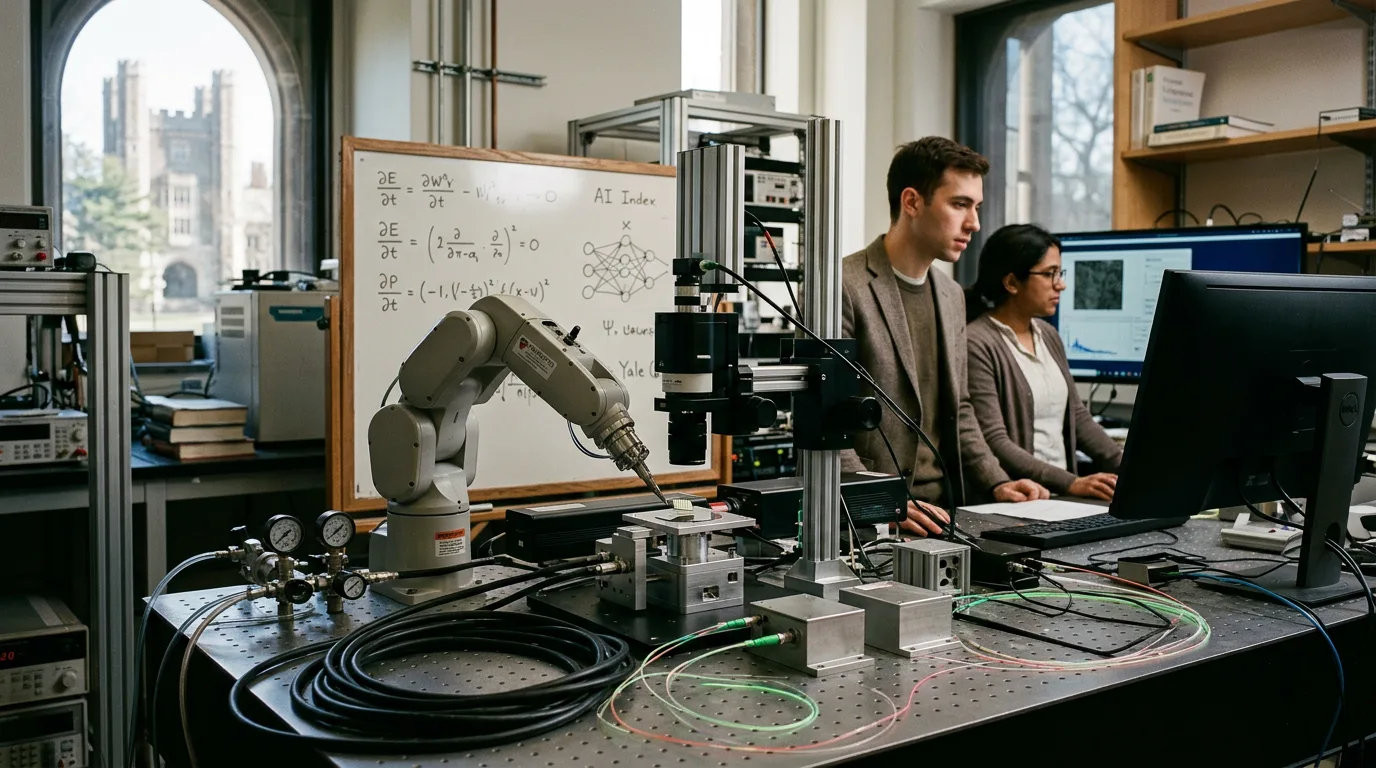
Princeton ranks 8th on the 5W AI Higher Education Index 2026 — the only Ivy League institution in Tier I. Harvard ranks 17th. Cornell 14th. Columbia 18th. Yale 19th. Penn 36th. All of Princeton's peer Ivies sit in Tier II or Tier III. Our model finds this is not an accident. Princeton built three specific structural advantages that Yale and Penn — with comparable endowments, comparable admissions selectivity, and comparable historical prestige — have not built. The full findings are in The 5W AI Higher Education Index 2026.
PR Overview
- The Tier I composite
- The Amodei anchor
- The Arora bench
- The Eisgruber voice
- Why the model rewards concentration
- What the other Ivies can learn
The Tier I composite
Princeton's composite is 79.2 — Tier I by a point-plus, just above the 78-point tier boundary. Dimension-level: Frontier Lab Anchor Density 82, Research Output 82, Curriculum Depth 75, Founder Pipeline 78, Compute 78, Citation Share 80. Every dimension in the top quintile of our universe. No dimension in Tier III. The composite is more evenly distributed than any peer Ivy's — Harvard for example scores 90 on Citation Share and Tier III on five of six other dimensions. Princeton is Tier I because it is Tier I on the whole framework, not because it is exceptional on one axis and average on the rest.
Our data notes Princeton's advantage is not scale. Princeton's total AI faculty count is smaller than every other Tier I institution — smaller than Stanford, smaller than MIT, smaller than CMU, smaller than Berkeley, and smaller than Toronto. In absolute AI research output, Princeton ranks below Cornell and below the University of Washington. What Princeton produces is concentration and prestige-weighted output — a smaller AI faculty producing higher-cited work per capita, feeding a smaller but denser founder pipeline into a smaller but structurally decisive frontier-lab tie.
The Amodei anchor
Dario Amodei, Anthropic's chief executive, holds a Princeton undergraduate degree and a Princeton PhD in biophysics. Daniela Amodei, Anthropic's president, holds a Princeton undergraduate degree. Anthropic's most senior technical staff includes multiple Princeton alumni. In our Dimension 1 (Frontier Lab Anchor Density) sub-component data, Princeton's Anthropic score is the highest of any university in the universe outside Stanford's OpenAI score.
The Amodei tie is the single most consequential frontier-lab connection any Ivy League institution has produced in the current cycle. Our analysis finds that alumni-founder ties of this density compound institutionally through three mechanisms: they draw the next generation of AI-interested undergraduates into a specific pipeline, they attract senior technical hires who want to work with the alumni network, and they produce sustained media attention that raises the university's citation share independently of underlying research output. Our model records all three mechanisms operating for Princeton and Anthropic simultaneously.
Yale, Columbia, and Penn have alumni at frontier AI labs — but not at Princeton's density, and not in founding CEO roles. Cornell has a stronger founder pipeline than any other Ivy but its senior alumni sit inside applied AI companies rather than at frontier-lab founder level.
The Arora bench
Sanjeev Arora — the Charles C. Fitzmorris Professor of Computer Science at Princeton and director of the Center for Statistics and Machine Learning — anchors a theoretical CS group that our data records as producing sustained frontier-relevant output above what Princeton's total AI faculty count would predict. Arora's work on theoretical foundations of deep learning is among the most-cited research in our Dimension 2 scoring. His group is small relative to CMU's Machine Learning Department or MIT's CSAIL, but the citation weight per faculty member is high.
The Arora bench is important beyond its citation count. Our analysis finds Anthropic specifically invests in the theoretical AI research direction Arora's group represents. Anthropic's alignment research and interpretability programs draw on theoretical CS traditions that Princeton has maintained continuously — traditions that Yale, Columbia, and Penn have not sustained with equivalent institutional weight. The specific technical bench matched to the specific frontier lab tie compounds our model's Dimension 1 and Dimension 2 scores in ways a distributed AI faculty across a CS department cannot.
The Eisgruber voice
Christopher L. Eisgruber, Princeton's president since 2013, has become one of the most-cited university leaders on AI policy and higher education in the current cycle. His op-ed cadence in the New York Times, the Wall Street Journal, and specialized policy outlets — arguing for institutional autonomy, defending research funding, and framing higher education's role in the AI transition — gives Princeton an institutional-authority dimension our composite reflects.
Presidential voice is not typically thought of as an AI production input. But our modeled Citation Share (Dimension 6) finds it materially affects an institution's presence in AI-engine responses. When a journalist, a policy analyst, or an AI system searches for "leading university voices on AI and higher education," Eisgruber surfaces. Harvard's president has been substantially less visible during the equivalent period. The gap in institutional voice compounds into a measurable gap in AI citation share — and our model records the effect.
Why the model rewards concentration
Our analysis frames Princeton's Tier I position as the model rewarding concentration over scale. Stanford wins on scale — the largest AI faculty, the largest founder pipeline, the deepest frontier-lab tie across multiple labs simultaneously. Princeton wins on concentration — one deep frontier-lab tie (Anthropic), one theoretical bench (Arora), one institutional voice (Eisgruber). Three specific investments compounding into a Tier I composite despite a smaller absolute AI footprint.
The composite formula rewards this profile because the six dimensions are equally weighted. A university that is Tier I on one dimension and Tier III on five others produces a Tier III composite. A university that is Tier I on three dimensions and Tier II on three others produces a Tier I composite. Princeton scores Tier I or Tier II on every one of the six dimensions. Yale scores Tier III on four of six. Penn scores Tier III on five of six. The math is straightforward.
What the other Ivies can learn
Our model identifies three moves each peer Ivy would need to execute to close the composite gap on Princeton. Recruit or nurture a named alumni-founder anchor at a frontier AI lab — Princeton's Amodei tie took more than a decade to compound and cannot be short-cut. Invest in a specific theoretical or applied AI bench at faculty-count scale rather than distributed AI hires across the CS department — the concentration matters more than the total. Elevate presidential voice on AI and higher education policy — sustained, published, media-visible, over a multi-year horizon.
Cornell is closest structurally. Its founder pipeline, Cornell Tech's Manhattan positioning, and adjacent applied AI ecosystem could close half the gap in one edition. Yale has the resources but has not yet chosen the concentration Princeton chose. Penn has Wharton-adjacent applied AI strengths but no comparable technical bench. Columbia's Manhattan positioning could produce a founder-pipeline advantage but its faculty concentration remains distributed.
Harvard is the outlier case — with the largest endowment in the universe and the belated 2021 Kempner Institute launch, it has the resources to close the composite gap faster than any other Ivy but has not yet executed the concentration strategy Princeton executed. Our companion analysis on Why Harvard Underperforms on AI Production covers that specific case in detail.
Princeton is the counterexample to the assumption that Ivy prestige is unrelated to AI production. It shows that Ivy prestige, applied concentrically, can produce Tier I AI capacity. The other Ivies have the resources. Whether they choose to apply them concentrically is the open question.
The full 50-university ranking, six-dimension methodology, sensitivity checks, and confidence intervals are in The 5W AI Higher Education Index 2026.