
Executive Summary
THE BANKS AI VISIBILITY INDEX 2026 · WEEK 01
Big Bank Bomb.
Ally wins. Wells Fargo whiffs. The top 25 U.S. banks ranked by AI citation share across ChatGPT, Claude, Perplexity, Gemini, and Google AI Overviews.
By Ronn Torossian, Founder of 5W, and the 5W Research Team — May 2026
The branch network won the twentieth century. AI is winning the next one.
The 2026 banking consumer doesn't walk into a branch. She opens ChatGPT and asks "best high-yield savings account" or "best bank for freelancers." What AI surfaces in that answer determines where her deposit goes — and the banks winning that surface are not the banks holding the deposits.
5W ran 66 consumer-intent prompts through ChatGPT, Claude, Perplexity, Gemini, and Google AI Overviews in Q2 2026, tracking citations across six sub-categories: high-yield savings, checking, CDs and money markets, credit cards, small business banking, and wealth and brokerage.
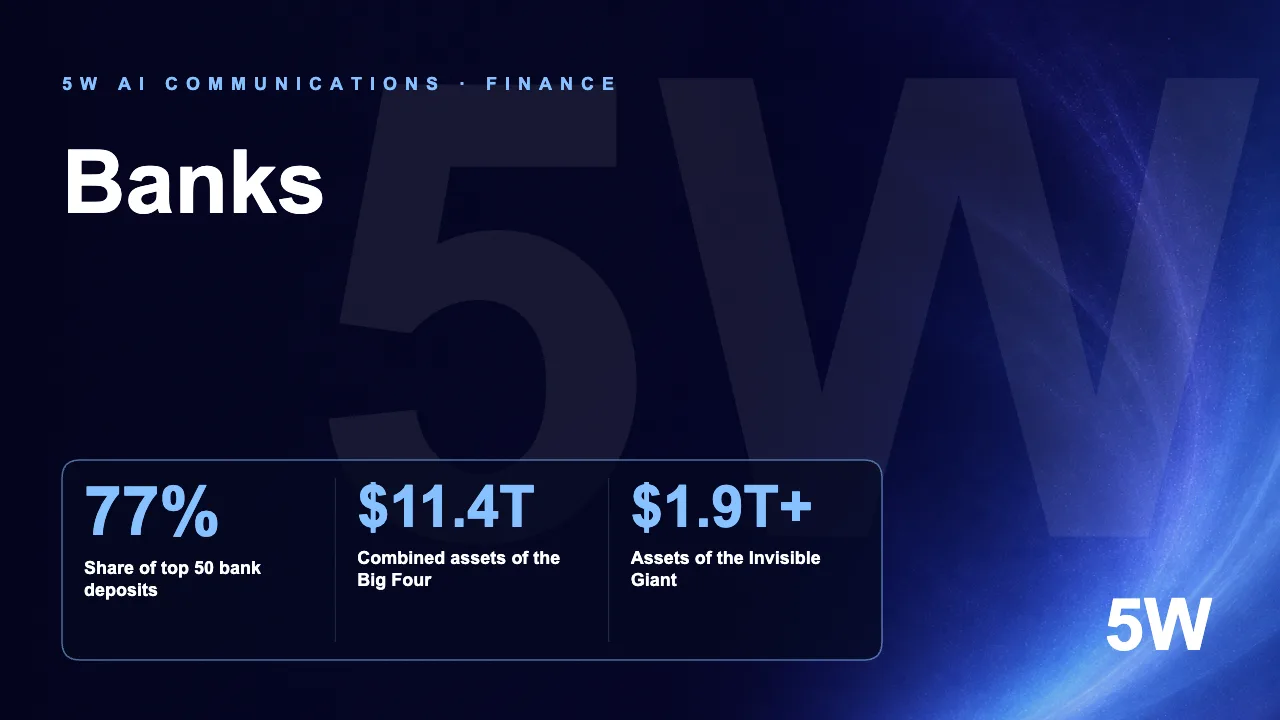
The findings: Ally Bank wins HYSA and online checking citations outright. Marcus by Goldman Sachs and SoFi split online-deposit recommendation. JPMorgan Chase holds the only credible Big Four AI position, anchored by Sapphire. Wells Fargo — $1.9 trillion in assets, third-largest U.S. bank — does not crack the top 20 in any consumer-intent prompt we tested. The Big Four hold roughly 77% of deposits among the top 50 U.S. banks. They hold a fraction of the AI recommendation share.
Top 15 Brands by AI Citation Share
Estimated share of brand citations across 66 banking consumer prompts run through five AI engines, Q2 2026.
Where the answer goes.
01
Ally Bank
9.2%
02
Chase (JPMorgan)
7.8%
03
SoFi
6.5%
04
Marcus by Goldman Sachs
5.4%
05
Capital One
5.1%
06
Discover Bank
4.8%
07
Charles Schwab Bank
4.2%
08
American Express Nat'l Bank
3.6%
09
Navy Federal Credit Union
3.4%
10
Bank of America
3.1%
11
Citi
2.9%
12
Fidelity Cash Management
2.7%
13
US Bank
2.4%
14
PNC
2.2%
15
Synchrony Bank
2.0%
Color key: red — online-first banks; black — branch-network legacy banks. Share represents estimated proportion of brand citations across 66 tracked consumer prompts. Remaining ~38% split across ranks 16–25, unranked banks, and sub-category-specific brands. Source: 5W analysis of AI-generated responses, Q2 2026.
The Full Top 25 Ranking
01
Online-first · HYSA leaderThe category-leading bank by AI citation share. Wins virtually every "best HYSA," "best online checking," and "best CD" prompt. Reddit r/personalfinance consensus locked in for a decade. ~$200B assets — a fraction of the Big Four, a multiple of their AI share.
Ally Bank
02
Big Four · Card-anchoredThe only Big Four bank with a credible AI position. Sapphire Preferred and Sapphire Reserve carry travel-card retrieval; the broader Chase brand benefits. Ubiquitous brand recognition translates.
JPMorgan Chase
03
Online-first · Multi-productMulti-product retrieval — HYSA, personal loans, investing, mortgages — gives SoFi the broadest AI footprint of any challenger bank. The fastest-growing AI-cited bank in the index.
SoFi
04
Online-first · DepositsOwns "best HYSA" share alongside Ally. Goldman Sachs brand prestige carries clinical-credibility weight AI engines surface in deposits queries.
Marcus by Goldman Sachs
05
Hybrid · Card-ledCredit card retrieval dominance — Venture, Quicksilver, Savor. Pending Discover acquisition compounds positioning.
Capital One
06
Online-first · CashbackStrong "cashback credit card" and "best checking with no fees" retrieval. Customer service citations consistently positive across Reddit.
Discover Bank
07
Investment-attachedCash management account dominates "best brokerage with checking" prompts. International ATM rebates a durable retrieval anchor.
Charles Schwab Bank
08
Investment-attachedPersonal Savings HYSA wins in "Amex deposits" queries. Brand-prestige halo from the card business.
American Express National Bank
09
Credit UnionStrong retrieval for military-eligibility and "best credit union" queries. Top-ranked credit union in AI answers.
Navy Federal Credit Union
10
Big Four · Brand-onlyCarries brand awareness but routinely loses to Ally, SoFi, Marcus in consumer-product prompts.
Bank of America
11
Big Four · Travel-cardCiti Strata Premier wins "best premium travel card" share. Otherwise underweighted vs. market scale.
Citi
12
Investment-attachedStrong retrieval for "best cash management" and "no-fee account" prompts. Heavily cited in Bogleheads.
Fidelity Cash Management
13
Super-regionalWins "best bank in Midwest" niche queries. Limited consumer-prompt visibility nationally.
US Bank
14
Super-regionalVirtual Wallet gets retrieval in checking comparisons. Underweighted overall.
PNC
15
Online-firstStrong HYSA retrieval. Co-brand card business diluted by store-card associations in consumer perception.
Synchrony Bank
16
Super-regionalLimited consumer-prompt visibility. Northeast brand familiarity does not transfer to AI.
Citizens
17
Online-firstHYSA retrieval competitive but lower brand recognition. First Citizens parent provides scale but not visibility.
CIT Bank
18
Super-regionalThe BB&T/SunTrust merger has not produced AI citation share. Brand recognition still consolidating.
Truist
19
Super-regionalCanadian heritage carries some retrieval; weak in U.S. consumer-product queries.
TD Bank
20
NeobankAI engines flag as fintech rather than bank, which reduces visibility in "safe bank" prompts. Top fintech, not top bank.
Chime
21
Credit UnionStrong in "credit union" comparisons. Limited reach beyond eligible-member niches.
PenFed Credit Union
22
Big Four · Invisible Giant$1.9 trillion in assets. Below the top-20 in every consumer-intent prompt. The 2016 fake-accounts scandal is a permanent Wikipedia retrieval anchor.
Wells Fargo
23
NeobankUnderweighted. AI engines surface Chime first when challenger-bank prompts come up.
Varo
24
NeobankNiche teen and young-adult retrieval. Limited beyond demographic-specific prompts.
Current
25
Investment BankSurfaces in "best private wealth" and high-net-worth prompts. Less in core consumer banking.
Goldman Sachs (private wealth)
Key Findings
Eight stats that tell the story.
9.2%
Ally Bank's estimated AI citation share — highest in the index.
22%
Combined AI share of the top 4 online-first banks (Ally, SoFi, Marcus, Capital One).
77%
Share of top-50 U.S. deposits held by Big Four — vs. their AI recommendation share.
$1.9T
Wells Fargo assets — ranked #22 in our index.
0
Big Four banks ranked in the top 5 for "best high-yield savings" prompt.
1.4x
Citation premium earned by online-first banks vs. branch-network peers.
66
Consumer-intent prompts tested across 5 AI engines.
6
Sub-categories tracked separately — citation share differs materially across each.
The Central Finding
American banking AI citations route through product specificity, not brand recognition. Consumers don't ask "is JPMorgan Chase a good bank." They ask "best HYSA," "best business checking," "best credit card for groceries." AI engines surface the bank that wins the product query — and the banks winning the product queries are Ally, SoFi, Marcus, Capital One, Discover. The Big Four built on branches. AI doesn't see branches.
The structural implication: banking AI citation share is determined by product-category leadership and Reddit-and-Bankrate consensus — not by deposit base, branch count, or marketing spend. Ally's citation moat is built on a decade of Reddit r/personalfinance, NerdWallet, and Bankrate "best of" placements. The Ordinary's playbook in beauty is Ally's playbook in banking. Wells Fargo cannot buy its way out of the position the CFPB filings, fake-accounts coverage, and Wikipedia entries have built around its name. JPMorgan Chase is the only Big Four bank that has built a defendable product position (Sapphire) — and it is the only Big Four bank with credible AI share.
Methodology
66 prompts. 5 engines. Six sub-categories.
5W analyzed 66 common banking-consumer prompts across six sub-categories. We identified which banks AI models consistently surface, which editorial and authoritative sources feed those citations, and where the largest gaps sit between commercial scale and AI visibility.
Sub-categories tracked
High-Yield Savings (Ally, Marcus, SoFi, Discover, Amex, Synchrony, CIT). Checking (Chase, BofA, Ally, Capital One, Discover, Schwab, Charles). CDs & Money Markets (Marcus, Capital One, Synchrony, Ally, Discover). Credit Cards (Chase, Amex, Capital One, Discover, Citi). Small Business Banking (Chase, BofA, Bluevine, Mercury, Relay, Novo, Found). Wealth & Brokerage (Schwab, Fidelity, Vanguard, Goldman, Morgan Stanley).
Query types tracked
Real-world consumer prompts including "best high-yield savings account," "best checking account with no fees," "Ally vs Marcus vs SoFi savings," "Chase Sapphire vs Amex Gold," "best bank for freelancers," "best private bank for $1 million," "where do millionaires keep their cash," "is Marcus by Goldman Sachs safe," and 50+ additional variations covering rate, fee, business, wealth, and brand-comparison intent.
Citation sources tracked
Personal finance editorial (NerdWallet, Bankrate, The Points Guy, DoctorOfCredit, Investopedia, Wirecutter, The Strategist), Reddit communities (r/personalfinance, r/Bogleheads, r/CreditCards, r/churning), Bogleheads forum, Wikipedia (entity and scandal pages), CFPB complaint database, FDIC consumer-data resources, and brand-owned content.
Important framing
This index measures AI citation share for marketing and communications strategy purposes. It does not rank banks on product safety, deposit security, customer satisfaction, or financial soundness. Banking decisions should be informed by direct review of FDIC insurance, terms, fees, and product fit.
Winners
Who's winning the answer.
The online-first quartet (Ally, SoFi, Marcus, Capital One).
Together account for an estimated 22% of all banking AI citations across 66 tracked queries. Ally wins HYSA and online checking through a decade of Reddit, NerdWallet, and Bankrate consensus. SoFi wins on multi-product breadth — checking, savings, investing, loans, mortgages — and a brand built around millennial mass affluence. Marcus wins on Goldman Sachs prestige translating into deposit credibility. Capital One wins on cards and on hybrid online/physical positioning. The four-bank tier is meaningfully separated from challengers ranked 5–15.
Chase's only-defendable-Big-Four position.
JPMorgan Chase is the single Big Four bank with a credible AI citation footprint, and it is built on one product line: Sapphire. Chase Sapphire Preferred and Sapphire Reserve are universally cited in "best travel credit card" and "best premium card" answers. The Sapphire halo carries upward into checking, savings, and brand-recognition queries. Bank of America, Citi, and Wells Fargo do not have a Sapphire equivalent.
Discover's quiet citation lock.
Discover wins "best cashback credit card," "best checking with no fees," and "best customer service bank" prompts across all five engines. The Capital One acquisition (pending close) compounds an already-strong card position. Discover's Reddit reputation for customer service is the single most-cited consumer banking authenticity signal.
Schwab and Fidelity in the wealth-adjacent queries.
Charles Schwab Bank and Fidelity Cash Management each earn outsized AI share in "best cash management," "best brokerage with checking," and "Schwab vs Fidelity vs Vanguard" prompts. The investment-bank-attached model produces compounding citation across both banking and brokerage queries — a structural advantage Goldman's Marcus also benefits from.
Navy Federal as the institutional credit union default.
Navy Federal wins "best credit union," "best bank for military families," and most credit-union-adjacent prompts. Eligibility limits do not reduce AI citation share. PenFed is the only other credit union to surface meaningfully — and at materially lower share.
Falling Behind
Who's losing the answer.
Wells Fargo's near-total AI invisibility.
$1.9 trillion in assets, third-largest U.S. bank, mass branch network — and ranked #22 in our index. The 2016 fake-accounts scandal is a permanent Wikipedia retrieval anchor that AI engines reference whenever a Wells Fargo product query surfaces. CFPB filings, settlement coverage, and Reddit consensus all stack negatively. AI does not see the branches. It sees the filings.
Bank of America and Citi's brand-without-product positions.
Both banks carry massive brand recognition that does not translate. Bank of America surfaces in "biggest US banks" entity-recognition prompts but loses every consumer-product query to Ally, SoFi, Marcus. Citi has Strata for premium travel cards and almost nothing else. Neither bank has a Sapphire — a product that wins a category prompt at consumer scale.
The super-regionals (Truist, US Bank, PNC, TD, Citizens).
Each holds tens of billions in assets and regional brand recognition. None hold national AI citation share above 2.5%. Truist (the BB&T/SunTrust merger) has been the most invisible — the merged brand has not produced a citation event AI engines absorbed. US Bank's Midwest niche surfaces only in geographically-anchored prompts.
The neobanks beyond Chime.
Chime holds the #20 position as the top neobank — but AI engines flag Chime, Varo, and Current as "fintech" rather than "bank," routing safety-sensitive prompts to FDIC-insured incumbents. The neobank category's citation ceiling is structural until AI engines reclassify the cohort.
Private banks without a public product.
Morgan Stanley, Goldman Private Wealth, JPMorgan Private Bank — each holds significant private-wealth share but produces minimal citation share. The "best private bank for $1 million" prompt is fractured across Schwab, Fidelity, Goldman, Morgan Stanley, Vanguard — no dominant AI answer. The Citation Vacuum here is a massive opportunity for the first private-banking brand to plant a public product story.
The Six Structural Findings
What the data actually says.
- Banking AI citation share is driven by product-specific leadership, not brand recognition. Ally wins HYSA. Chase wins Sapphire. Discover wins cashback. The Big Four brand-only banks lose to product-specific winners every time.
- Reddit r/personalfinance is the single most-weighted consumer banking AI source. A decade of Reddit consensus has hardened around Ally, SoFi, Marcus, Discover, Schwab, Fidelity. Banks that ignored Reddit ten years ago cannot buy the position back.
- Online-first banks earn a 1.4x citation premium over branch-network peers. AI engines do not weight branch count. They weight product transparency, rate competitiveness, and consensus.
- Wikipedia is a permanent negative anchor for scandal-touched banks. Wells Fargo's 2016 fake-accounts pages, every Wall Street settlement page, every CFPB consent order — all surface when an AI engine evaluates the brand for a consumer query.
- Investment-bank-attached deposit accounts compound citation share. Goldman's Marcus, Schwab's Bank, Fidelity's Cash Management, Amex's National Bank — all benefit from prestige halo plus product specificity. The structural advantage is real and growing.
- Credit unions and neobanks are siloed in AI answers. Navy Federal and Chime both surface at the top of their categories but rarely cross into general "best bank" prompts. The category labels stick.
2026-Specific Findings
What's moving this year.
- SoFi's multi-product expansion compounded citation share in Q1. The launch of expanded investing products and the continued mortgage push produced citation events AI engines absorbed across Reddit and NerdWallet.
- The Capital One – Discover deal continues to anchor card-category citations. The merger announcement and approval cycle has produced sustained editorial coverage that compounds both brands' AI citation footprint.
- Marcus's HYSA rate parity with Ally has narrowed the citation gap. Where Ally held a 2-point AI share lead in 2024, it holds a 3.8-point lead in 2026 — but Marcus has gained on Ally specifically in "safest HYSA" and "Goldman Sachs deposits" prompts.
- Wells Fargo's continued absence from AI answers is now a publishing story. The bank has had no major product launch credible enough to displace the 2016 scandal anchor. Each new Reddit and personal finance editorial cycle further hardens the negative position.
- The neobank cohort is consolidating around Chime. Varo and Current have lost AI citation share to Chime over the past four quarters. AI engines now route most "challenger bank" queries through Chime first.
- The "best bank for freelancers" Citation Vacuum is widening. Mercury, Bluevine, Novo, Found, Relay rotate without consensus. The first brand to plant a definitive Reddit/NerdWallet consensus position will absorb the category.
From Ronn Torossian, Founder of 5W
Ronn Torossian
Founder & Chairman · 5W AI Communications
"Wells Fargo didn't lose AI share because the AI is broken. It lost because for a decade, every Reddit thread, every NerdWallet best-of, every CFPB filing was written about someone else. The AI is reading the work nobody bothered to do. The branch network won the twentieth century. The AI answer is winning the next one — and the banks winning it are the banks the Big Four didn't think were competitors."
The Banks GEO Playbook
Eight moves that earn AI share.
- Audit AI citation share by product, not by brand. Brand-level rollups conceal the gaps. Audit citation share for "best HYSA," "best business checking," "best cashback card" — the prompts that actually drive consumer decisions.
- Publish product comparison content the incumbents will not write. Ally's pages comparing itself to Marcus, SoFi, Wealthfront earn citation share. Wells Fargo's refusal to publish "Wells Fargo vs Ally" content is exactly why Wells Fargo loses the prompt.
- Earn placement in NerdWallet, Bankrate, Wirecutter, and DoctorOfCredit "best of" lists. These pages are AI retrieval anchors. Editorial placement compounds for years. Earn it with rate competitiveness, fee transparency, and structured product data.
- Build a Reddit presence through customer support, not marketing. Authentic Reddit mentions compound AI citation share. Manufactured Reddit campaigns get detected and reduce trust signals.
- Maintain Wikipedia entries with sourced product history. Wikipedia is an entity anchor. Banks with thin or scandal-only Wikipedia presence rank lower across all categories.
- Publish structured data on rates, fees, and FDIC status. AI engines surface machine-readable banks first. Make every product page parseable.
- Pursue category leadership in one Citation Vacuum. "Best bank for freelancers," "best private bank for $1 million," "best international wire transfer" — each is wide open. The first bank to anchor consensus owns the category for years.
- Treat regulatory filings and product launches as citation events. Calendar AI-citation audits within 72 hours of every major announcement. Capture the citation lift while editorial coverage is fresh.
The Bigger Picture
Where this goes next.
American banking is the most concentrated industry 5W has measured for AI citation share. The Big Four hold 77% of top-50 deposits. They hold less than 15% of consumer-banking AI citation share. The gap is the largest of any consumer category we track — and it is not closing.
The implication is structural. Deposit growth in the next decade will route through the brands that win the citation surface, not the brands that hold the branches. The Big Four can either build product-specific positions that earn AI share — what Chase has done with Sapphire — or watch deposit share migrate to online-first banks one product query at a time.
The banks that win the next decade will publish product comparisons their competitors are afraid to publish, defend Wikipedia and Reddit consensus as if it were a credit rating, and treat AI citation share as the leading indicator of deposit growth. The banks that treat AI citation as a marketing curiosity will watch Ally, SoFi, Marcus, Capital One, Discover, and a small number of others absorb a larger and larger share of what consumers see when they ask "where should I put my money" in 2026 and beyond.
AI citation share is the scoreboard. In banking, the scoreboard is determined by product leadership and Reddit-and-Bankrate consensus. The banks that build for that scoreboard win. The banks that build for the branch-network scoreboard of a previous era do not.
About 5W
5W is the AI Communications Firm, building brand authority across the platforms where decisions now happen — ChatGPT, Claude, Perplexity, Gemini, and Google AI Overviews — alongside earned media, digital, and influencer channels. 5W combines public relations, digital marketing, Generative Engine Optimization (GEO), and proprietary AI visibility research, helping clients measure and grow their presence in AI-driven buyer research.
Founded more than 20 years ago, 5W has been recognized as a top U.S. PR agency by O'Dwyer's, named Agency of the Year in the American Business Awards®, and honored as a Top Place to Work in Communications in 2026 by Ragan. 5W was also named to the Digiday WorkLife Employer of the Year list.
For more information, visit www.5wpr.com.
FAQ
Frequently asked.
What is the Banks AI Visibility Index 2026?
A 5W research report ranking the top 25 U.S. banks by estimated AI citation share across ChatGPT, Claude, Perplexity, Gemini, and Google AI Overviews. It measures which banks AI answer engines surface for consumer-intent prompts about high-yield savings, checking, CDs, credit cards, small business banking, and wealth.
Which bank ranks highest?
Ally Bank leads all U.S. banks by AI citation share, with an estimated 9.2%. JPMorgan Chase (7.8%), SoFi (6.5%), and Marcus by Goldman Sachs (5.4%) complete the top four.
Why does Wells Fargo rank so low?
Wells Fargo's $1.9 trillion in assets do not produce AI citation share because consumer-banking queries route through product-specific authority — and Wells Fargo does not hold leadership in any category prompt we tested. The 2016 fake-accounts scandal also produces a permanent Wikipedia retrieval anchor that AI engines reference in Wells Fargo product queries.
How was AI citation share measured?
5W ran 66 consumer-intent prompts through five AI engines in Q2 2026 and measured the frequency of brand citations across all responses, including product-and-feature-specific variations. Citation share is the proportion of total brand mentions captured by each bank.
Why does AI citation share matter for banks?
The 2026 banking consumer asks ChatGPT for "best high-yield savings account" before she opens a bank app. What AI surfaces in that answer determines where her deposit goes. Banks that win citation share win consideration; banks that lose citation share lose the consideration window entirely.
Is the report free?
Yes. The web version is free to read and the PDF download is ungated. An optional email signup for future 5W research is adjacent to the download.
Can 5W run a Generative Engine Optimization program for my bank?
Yes. 5W's Generative Engine Optimization practice is detailed at 5wpr.com/practice/geo-optimization. Financial Services GEO is offered through 5W's Financial Services & Fintech practice.
Why now?
Because the citation window is narrow. AI engines concentrate citations in a small number of domains per topic, meaning early movers pull forward into positions that are hard for later entrants to dislodge. The banks that invest in the next six months will be cited for years.
Disclosure
The Banks AI Visibility Index 2026 · Week 01 · May 2026© 2026 5W AI CommunicationsFull report
Read the PDF
Related
More from the series
Get in touch
Let's build your next chapter.
Tell us what you're working on. A senior strategist will respond within one business day.
- info@5wpr.com
- Phone
- 212.999.5585
- Address
- 469 7th Avenue, Floor 8, New York, NY 10018