Most communications budgets are still aimed at the outlets that win clicks. The engines that now sit between a brand and its buyers - ChatGPT, Claude, Gemini, Perplexity, Google AI Overviews - are citing a different list.
This report documents that list and the system behind it. It is written for two readers: the communications leader deciding where to spend earned-media effort, and the brand or institutional leader deciding what that effort is worth. The conclusion is the same for both: the media hierarchy public relations has priced for two decades is being repriced inside AI retrieval systems, and most organizations have not measured the move.
1. AI citation is not search - and the difference is the whole story
Search ranked pages. AI retrieval ranks sources. That is not a cosmetic change; it is a different machine, and it rewards a different kind of authority.
Six mechanics separate the two. They are worth naming, because every finding in this report follows from them.
Training exposure
A model's baseline knowledge is shaped by what it was trained on. Sources that appear at massive scale in training data - Wikipedia, Reddit, large reference corpora - carry weight before a single live query is ever run.
Retrieval weighting
When an engine pulls live sources to answer a question, it does not return ten blue links. It selects three to six sources it assesses as most extractable and most reliable.
Structured factual extraction
AI systems reward content a machine can lift cleanly: clear claims, defined entities, tables, and consistent formatting.
Entity reinforcement
Engines build confidence in a brand, person, or product by seeing it described consistently across many independent sources.
Community validation
Forums and review platforms function as crowd-verified signal, which is why Reddit and review sites punch far above their traffic.
Conversational query behavior
People ask AI engines longer, more specific, more comparative questions than they ever typed into Google.
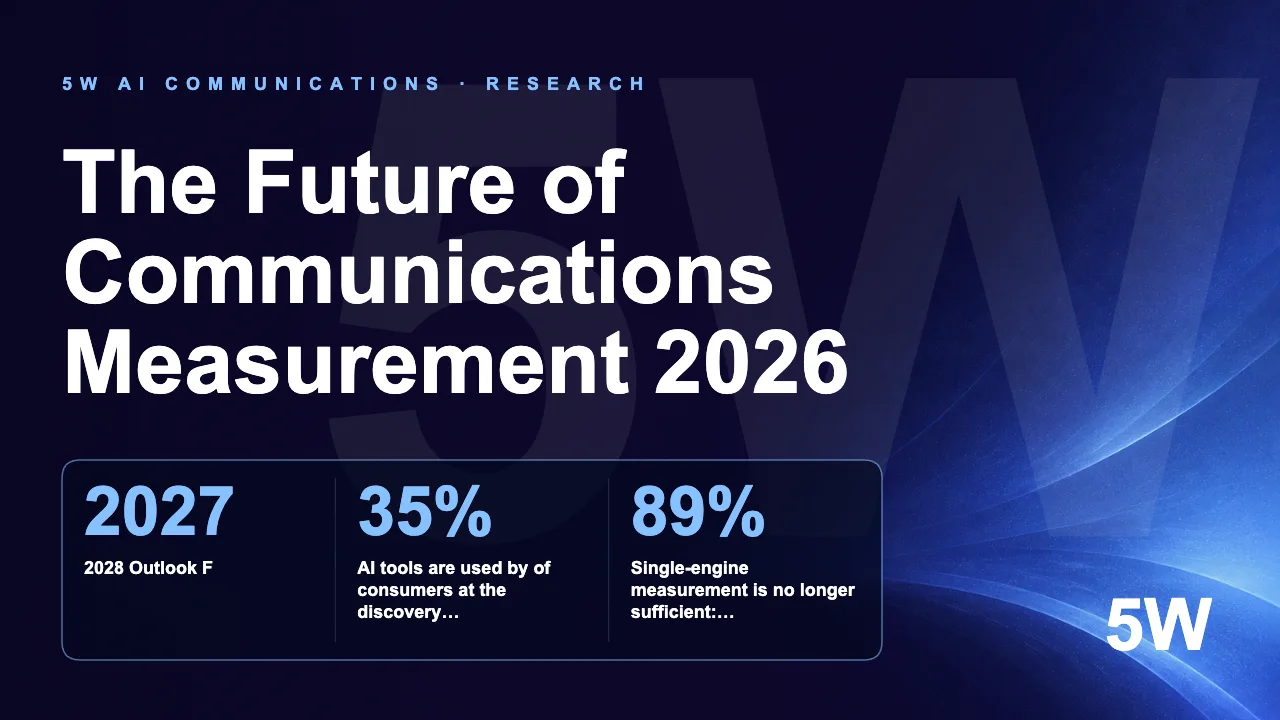
The 5W First-Stop Study documents the consequence: AI engines are increasingly the first stop in product and vendor research. AI and the Brand, a companion 5W study, puts a figure on it: 35% of consumers now begin product discovery inside an AI engine. And the overlap between the two systems is thin - per Ahrefs, only about 12% of AI citations match Google's top 10 results.
35%of consumers now begin product discovery inside an AI engine.12%of AI citations overlap with Google's top 10 results.5major answer engines now shape brand discovery.2. Wikipedia and Reddit beat The Wall Street Journal, The Times, and Bloomberg - combined
The most striking finding in the data concerns the publications public relations prizes most.
The Citation Source Audit - Q1 2026 synthesized nine independent datasets to establish which sources the major engines actually cite. The result reorders the board. The Wall Street Journal, The New York Times, Bloomberg, and the Financial Times do not appear in the top 20 cited domains. Forbes is the only U.S. business publication that does - ranked #18, at 1.38% citation share. Reuters, at #7 and 2.27%, outranks it.
Two non-news sources do most of the work. The audit found Wikipedia at 13.15% and Reddit at 11.97% - together more than a quarter of every ChatGPT citation in the United States. A free encyclopedia and a message board out-cite the entire prestige business press, not by a margin but by an order of magnitude.
13.15%Wikipedia citation share in U.S. ChatGPT citations.11.97%Reddit citation share in U.S. ChatGPT citations.25%+combined share from Wikipedia and Reddit.This is not gradual erosion. It is a structural repricing of authority inside AI retrieval systems - and most brands have no measurement in place to see it move.
3. The Times is suing its way out of the answer box
The New York Times is the most instructive case in this report, because the conventional read of its situation is exactly backward.
The Citation Source Audit established the plain fact: The New York Times is not among the top 20 sources cited by AI engines. The conventional read says the Times is a victim of AI disruption. The record says the Times is, in significant part, doing this to itself.
- It blocked OpenAI's GPTBot crawler as early as August 17, 2023 and rewrote its terms of service to bar the use of its content for AI training.
- It is now suing OpenAI. In that litigation, it demanded OpenAI hand over 20 million private user ChatGPT conversations.
- It is not alone in blocking, only in litigating: 49.4% of all news sites now block GPTBot, making it the single most-blocked AI crawler on the web.
- Meanwhile, the Financial Times, Time, and Axios signed licensing deals with OpenAI. The Times did not.
Click-through from AI chatbots runs about 0.33%, against 8.6% from Google Search. The Times is fighting a channel that was never going to send it meaningful traffic while making itself harder to be cited inside it.
49.4%of news sites now block GPTBot.0.33%estimated click-through from AI chatbots.8.6%estimated click-through from Google Search.The Times remains a prestige asset for a human audience. As retrieval infrastructure inside ChatGPT, it is compromised by its own strategy.
4. A CNN hit is not worth what you are paying for it
CNN is the quieter version of the same story. Like the Times, it does not appear among the top-cited domains in the Citation Source Audit. Like the Times, it blocked GPTBot in 2023. Its referral traffic has fallen sharply as zero-click answers replace the click.
CNN remains valuable for human audiences and breaking news. As AI retrieval infrastructure, its influence is materially weaker than its traditional prestige suggests - and a Generative Engine Optimization-aware media plan should price it accordingly.
5. A consumer tech site outranks Bloomberg inside the answers that decide software deals
This is the finding that should change how B2B communications budgets are built.
In category-level citation data, TechRadar - a consumer technology publication - holds 8.86% citation share in B2B SaaS CRM. That is the highest single-category figure observed across any subcategory studied. Inside the answers buyers get when they research enterprise CRM software, a consumer gadget reviewer is the dominant cited authority.
It is not alone. G2, a user-review platform, is cited more frequently in software answers than technology publications, vendor websites, and analyst firms. Inside an AI buying answer, a crowd-review site can outrank Gartner and Forrester.
8.86%TechRadar citation share in B2B SaaS CRM.69%of B2B software buyers selected a different vendor than planned because of a chatbot.45%say a software-review citation is the most trust-inspiring signal in an AI answer.The mechanism is the one named in Section 1: community validation and structured extraction. Review platforms produce exactly the crowd-verified, machine-readable signal AI systems are built to reward. Prestige business press does not.
6. Market share is a lagging indicator. Citation Share is a leading one.
AI visibility does not track the things marketers have always measured - and the 5W AI Visibility Index series shows the gap, category by category.
In the U.S. Grocery Retail AI Visibility Index, Walmart - holding roughly 21% of U.S. grocery market share - ranks only fourth in AI citation share, behind Costco, Trader Joe's, and Whole Foods. The largest grocer in the country is not the most-cited grocer in the answer box.
In the Online Universities AI Visibility Index 2026, Western Governors University leads at 14% citation share while the University of Phoenix captures just 1.5% despite category-leading paid-search spend. Paid search bought visibility on Google. It did not buy a position inside AI retrieval.
And the NFL Citation Share Index 2026 - the first AI visibility ranking of all 32 franchises, built across 750 prompts and five engines - shows the same disconnect between market size and retrieval position.
Citation Share is a separate asset. It has to be measured and built on its own terms - and because it is not yet measured by most competitors, the brands that measure it first move into open field.
7. The new authority layer - a citation tier list
Drawing on the Citation Source Audit and the AI Visibility Index series, here is the hierarchy that should drive budget.
Community and reference
Reddit is the single most-cited domain across every major engine. Wikipedia sits beside it - 5W's Wikipedia for Brand Authority research found Wikipedia accounts for nearly half of all ChatGPT citations.
Structured platforms
YouTube - the YouTube AI Citation Share Report, an analysis of 46 million Google AI Overview citations, found YouTube now accounts for 23% of every Google AI answer. LinkedIn is increasingly dominant in B2B and executive-leadership queries.
Wire and structured editorial
Reuters and Forbes are the two news survivors in the Citation Source Audit. Structured outlets outperform prestige mastheads because AI systems reward extractable structure over institutional reputation.
Category trade and review
G2, TechRadar, Capterra, NerdWallet, and the vertical outlet that owns your category. In B2B, these routinely outrank everything above them.
Owned media
Necessary, not sufficient. It anchors the brand's own facts and reinforces the entity; it does not get cited at volume.
8. Earned media still wins - the target list changed
The most common misreading of this data: news is losing, so owned content wins. The opposite is true.
The 5W study AI and the Brand found that 85.5% of all AI citations come from earned, third-party media - not brand-owned pages. AI systems disproportionately rely on third-party references over brand-owned content. The engine reaches the brand's own site, when it does, mostly to confirm a fact it found elsewhere.
85.5%of AI citations come from earned, third-party media.23%of Google AI Overview answers cite YouTube.1.38%Forbes citation share in the Citation Source Audit.Earned media is not less important in the AI era. It is the mechanism. What changed is the list of outlets worth earning. If a media plan still prioritizes CNN visibility over Reddit authority or category-review platforms, it is likely mispriced for the AI retrieval era.
The same pattern appears in the Conde Nast AI Citation Portfolio, where structured publisher authority becomes a measurable citation asset, and in Future of Communications Measurement 2026, which frames citation share as a working metric for CMOs and CCOs.
And citation share compounds. Entity reinforcement means each consistent, well-structured mention makes the next one easier to earn. Early movers build a retrieval position that competitors must then displace - and displacement costs more than the original build.
From the 5W research library
This report draws on 5W's ongoing AI Visibility research.
- The Citation Source Audit - Q1 2026 - which sources ChatGPT, Claude, Perplexity, Gemini, and Google AI Overviews cite.
- The 5W AI Visibility Index series - category-level Citation Share rankings.
- The NFL Citation Share Index 2026 - the first AI visibility ranking of all 32 NFL franchises.
- The YouTube AI Citation Share Report - why YouTube owns 23% of every Google AI answer.
- AI and the Brand - 35% of consumers start discovery in AI; 85.5% of AI citations come from earned media.
- The First-Stop Study - AI vs. Google: where the buyer journey now begins.
- Wikipedia for Brand Authority - why Wikipedia drives nearly half of ChatGPT citations.
- Conde Nast AI Citation Portfolio - how one publisher planned for the shift.
- Future of Communications Measurement 2026 - Citation Share, the Retrieval Economy, and the operating plan for CMOs and CCOs.
FAQ
Does CNN or The New York Times matter for AI visibility?
Both still carry weight with human audiences, but neither appears in the top 20 sources cited by major AI engines, per the 5W Citation Source Audit. The New York Times has also blocked OpenAI's crawler and is in active litigation against the company, further reducing its presence inside ChatGPT.
What sources do AI engines cite most?
Reddit and Wikipedia lead across every major engine. In the Citation Source Audit, Wikipedia (13.15%) and Reddit (11.97%) together account for more than a quarter of U.S. ChatGPT citations. YouTube accounts for 23% of every Google AI Overview answer.
How is AI citation different from SEO?
AI retrieval ranks sources, not pages, and rewards training exposure, structured factual extraction, entity consistency, and community validation. Only about 12% of AI citations overlap with Google's top 10 results.
What is Citation Share?
Citation Share is the rate at which a brand is cited inside AI-generated answers across ChatGPT, Claude, Perplexity, Gemini, and Google AI Overviews. 5W measures it through the AI Visibility Index series and custom audits.
Methodology
This report is part of 5W's AI Visibility research program. It builds on 5W's published studies and indexes: the Citation Source Audit Q1 2026, the 5W AI Visibility Index series, the NFL Citation Share Index 2026, the YouTube AI Citation Share Report, AI and the Brand, the First-Stop Study, and Wikipedia for Brand Authority. It references external category data from Goodie AI, buyer-behavior research from G2, crawler and traffic data from Stanford GSB and the News Homepages project, and public court filings in The New York Times Co. v. OpenAI. AI citation behavior is volatile, engine-specific, and category-specific; results should be interpreted directionally rather than as permanent rankings.
5W is the AI Communications Firm, building brand authority across the platforms where decisions now happen - ChatGPT, Claude, Perplexity, Gemini, and Google AI Overviews - alongside earned media, digital, and influencer channels. 5W combines public relations, digital marketing, Generative Engine Optimization (GEO), and proprietary AI visibility research to help clients measure and grow their presence in AI-driven buyer research.