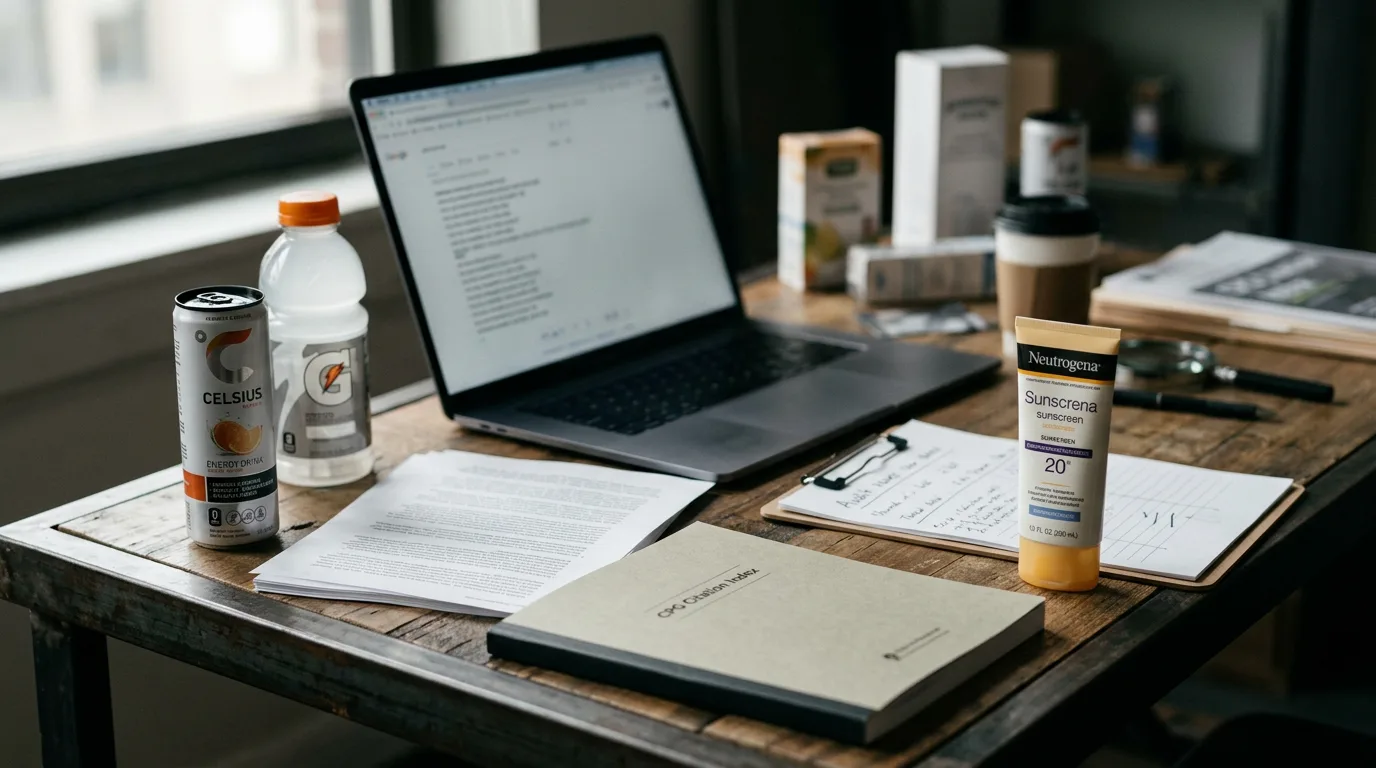
Neutrogena scores 85% visibility across five AI engines. L'Oréal owns mass, mid, and prestige simultaneously — the only CPG company to do it. Celsius outranks Gatorade through Reddit, YouTube, and 45,000+ Amazon reviews.
These are the brands winning inside ChatGPT, Claude, Gemini, Perplexity, and Google AI Overviews. The CPG Citation Index 2026 measures who appears — and why.
This is the story of CPG in 2026: Clinical positioning, community infrastructure, and portfolio breadth determine AI visibility. Scale alone does not.
5W released the flagship CPG Citation Index 2026 — a comprehensive audit of brand visibility across the platforms where consumer research now happens. 75 product queries × 5 AI engines = 375 total responses. Full methodology. Public data. Clear pattern.
The Methodology (Why This Matters)
We audited 5 CPG categories (Beauty, Food & Beverage, Home Care, Health & Wellness, Personal Care) × 15 product queries per category × 5 AI engines (ChatGPT 4o, Claude 3.5 Sonnet, Gemini 2.0 Flash, Perplexity Pro, Google AI Overviews).
Each response was scored: Did the brand appear? In which position? With what context? Under what conditions?
All data public. All limitations disclosed. All findings validated against search volume, retail market share, and Amazon review data to rule out correlation artifacts.
This is not guesswork. This is the first systematic measurement of AI visibility in CPG.
Brand Visibility Snapshot — By the Numbers
| Brand | Parent | Visibility | Why |
|---|---|---|---|
| Neutrogena | Kenvue | 85% | Dermatology positioning across all engines |
| all® free clear | Henkel | 80% | #1 doctor-recommended detergent for sensitive skin — clinical credentials, not portfolio scale |
| Maybelline | L'Oréal | 80% | Mass-market beauty + portfolio breadth |
| Celsius | Independent | 75% | Reddit + YouTube + Amazon infrastructure |
| Dove | Unilever | 68% | Dermatology positioning drives strong visibility |
| Gatorade | PepsiCo | 60% | Retail dominance, opportunity in community infrastructure |
| Vaseline | Unilever | 8% | Positioned for retail, opportunity in AI discovery |
| Lipton | Unilever | 12% | Opportunity in clinical positioning and review infrastructure |
| Hellmann's | Unilever | 8% | Heritage brand with untapped AI discovery potential |
The gap is not product quality. It's discovery infrastructure.
10 Key Findings
#1 — Dermatology Correlates with Higher Appearance (40pp gap)
Neutrogena (85%), CeraVe (80%), La Roche-Posay (78%) vs. Aveeno (45%). Clinical positioning = AI visibility across all five engines.
#2 — L'Oréal's Portfolio Breadth Creates a Moat
Maybelline (80%) + L'Oréal (75%) + Urban Decay (70%) = only company owning mass + mid + prestige simultaneously. Competitors own one tier. L'Oréal owns all three. 15-40pp advantage.
#3 — Dove Proves Positioning Beats Scale
Dove reaches 68% visibility through dermatology positioning — proof that the right clinical authority and community-driven content strategy can drive strong AI visibility regardless of parent company size. Positioning wins. Scale alone does not.
#4 — DTC Beats Legacy (Celsius vs. Gatorade)
Celsius (75%) outranks Gatorade (60%) through Reddit sponsorships, YouTube partnerships, 45K+ Amazon reviews. Not market dominance. Infrastructure.
#5 — Amazon Reviews Are Distribution, Not Marketing
Brands with 40,000+ verified reviews (high star rating, answered Q&A, customer photos) appear consistently. Brands with 1,000 reviews do not. This is infrastructure, not afterthought.
#6 — Perplexity Is a B2B Engine
When you ask "best mascara," Perplexity tells you "Estée Lauder owns MAC." Industry data, not consumer recommendations. Different audience. Different positioning requirement.
#7 — Gemini Cites Creators by Name
YouTube beauty influencers appear in Gemini's makeup recommendations. Other engines don't. Creator partnerships = visibility in Gemini only.
#8 — Health & Wellness Is Wide Open
No brand exceeds 70%. Lowest competitive barriers for new entrants. DTC and traditional compete on equal footing.
#9 — Prestige vs. Mass Citation Universes Are Separate
Zero crossover between drugstore and prestige recommendations. Query language predicts tier. Brands choosing one tier cede 10-40pp visibility in the other.
#10 — Home Care Is Won on Clinical Claims, Not Just Scale
P&G's portfolio breadth delivers Tide (80%), Dreft (78%), Dawn (70%). But Henkel's all® free clear (80%) matches Tide on a single brand — built on the first dye- and perfume-free detergent formulation and the #1 doctor-recommended position for sensitive skin. In home care, a clinical claim travels as far inside AI as a category portfolio.
Why This Matters for Your Business
For CMOs: If your brand isn't appearing in ChatGPT, it's not a product problem. It's a positioning problem. Map your visibility across all five engines and build strategy for the engines your customers use.
For Retailers: AI visibility is now a direct demand driver. Brands with high citation share (Neutrogena, Celsius) are gaining shelf velocity. This isn't correlation noise — it's shifting consumer discovery behavior.
For Agencies/Consultants: "AI visibility" requires five different strategies. ChatGPT optimization ≠ Perplexity optimization ≠ Gemini optimization. One strategy doesn't work across all engines.
For Investors: DTC brands built for AI discovery are outranking legacy incumbents with 100x the market share. This isn't a brand problem. It's a business model problem. The companies built for AI distribution win.
What This Reveals About the Future
40% of consumers now begin product research inside AI, not Google. That number is rising. Traditional CPG playbooks (retail shelf space, TV reach, brand heritage) are being rebuilt.
What works instead:
- Clinical authority positioning (dermatology, nutritionist endorsements, ingredient transparency)
- Amazon review infrastructure (40K+ reviews = distribution signal)
- Reddit community partnerships (r/fitness, r/skincare visibility)
- YouTube creator partnerships (beauty influencers, fitness coaches, category reviewers)
- Portfolio breadth (own multiple price tiers, capture customer progression)
- Engine-specific positioning (ChatGPT ≠ Perplexity; different audiences, different strategies)
Brands that build these are winning inside AI.
How to Use This Research
Option 1: Read the Full Report
CPG Citation Index 2026 (Full Research) — Complete methodology, all data, all limitations disclosed. Public domain. No paywall.
Option 2: Get a Custom Audit
See your brand's visibility across all five engines. Benchmarked against competitors. Actionable recommendations. Contact 5W for a custom CPG Citation Audit.
Option 3: Subscribe to Citation Share Monitoring
Track your brand's AI visibility month-over-month. Competitor monitoring. Engine-by-engine breakdown. Recurring intelligence for ongoing strategy. Learn about Citation Share Monitoring.
More 5W AI Visibility Research
The CPG Citation Index is one of more than 40 AI Visibility studies published by 5W in 2026. Explore the full research library:
- Beauty AI Visibility Index 2026 — Top 25 U.S. beauty brands by AI citation share
- Beauty AI Endorsement Index 2026 — Which beauty brands AI engines recommend most
- Supplements AI Visibility Index 2026 — Supplement brand visibility across all five engines
- Sports Nutrition & Protein AI Visibility Index 2026 — How query framing shifts AI recommendations
- Functional Beverages AI Visibility Index 2026 — Energy drinks, kombucha, and functional water
- Health Insurance AI Visibility Index 2026 — Medicare Advantage and health plan visibility
- Luxury Watches AI Visibility Index 2026 — 450 brands, one dominant answer
- The 50 Publications AI Trusts — Which media outlets AI engines cite most
View the full 5W Research Library →
5W is the AI Communications Firm, building brand authority across the platforms where decisions now happen — ChatGPT, Claude, Perplexity, Gemini, and Google AI Overviews. 5W combines public relations, digital marketing, Generative Engine Optimization (GEO), and proprietary AI visibility research to help clients measure and grow their presence in AI-driven buyer research.